AGU RESEARCH

Topics that shape the future
- Closer look at research results -

Aoyama Gakuin University faculty members:
He is an uncompromising researcher.
Aiming for a prosperous society,
We are always conducting cutting-edge research.
We will explore the research results of our faculty members who are shaping the future.

  • College of Economics Department of Public and Regional Economics
  • Published on 2025/11/04
  • The development and social application of a nationwide small-area future population projection system received the "2024 Symphonica Statistical GIS Activity Encouragement Award".
  • Professor Takashi Inoue
  • College of Economics Department of Public and Regional Economics
  • Published on 2025/11/04
  • The development and social application of a nationwide small-area future population projection system received the "2024 Symphonica Statistical GIS Activity Encouragement Award".
  • Professor Takashi Inoue

TOPIC

Professor Takashi Inoue was awarded the "2024 Symphonica Statistical GIS Activity Encouragement Award" by the Japan Statistical Information Research and Development Center for Public Interest Incorporated Foundation for his work on the development and social application of the "National Small-Area Future Population Projection System." This award is given to researchers who have made significant achievements in promoting and disseminating "Statistical GIS," which integrates Geographic Information Systems (GIS) and statistical information.

Symphonica Statistical GIS Activity Encouragement Award

The award is sponsored by the Japan Statistical Information Research and Development Center (Sinfonica), a public interest incorporated foundation. It is awarded to individuals or organizations that "actively engage in theoretical, technological development, and application activities related to 'Statistical GIS,' which integrates Geographic Information Systems (GIS) and statistical information, and have achieved, or are expected to achieve, significant results in promoting and disseminating Statistical GIS through these activities" (quoted from the foundation's website). (※Link to the foundation's website: https://www.sinfonica.or.jp/assist/)

Award-winning points

Until the early 2010s, there were virtually no examples of future population projections for areas smaller than municipalities on a national scale. In this context, Professor Inoue developed a unique method for leveling out projections by utilizing the concept of population potential, and further combined it with existing projection methods to propose a method for projecting future populations on a small-scale regional basis, which was highly praised.

Illustration: Arrow

Explore the topic with your teacher

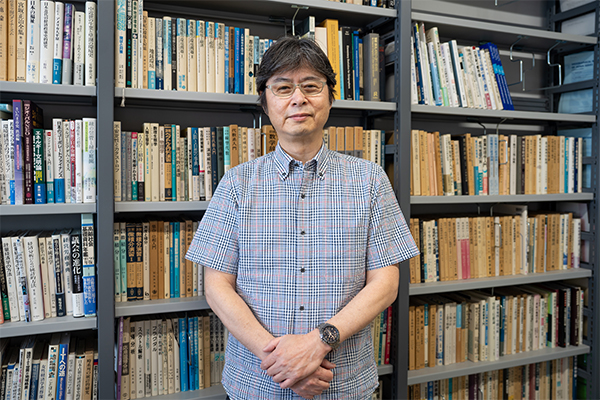
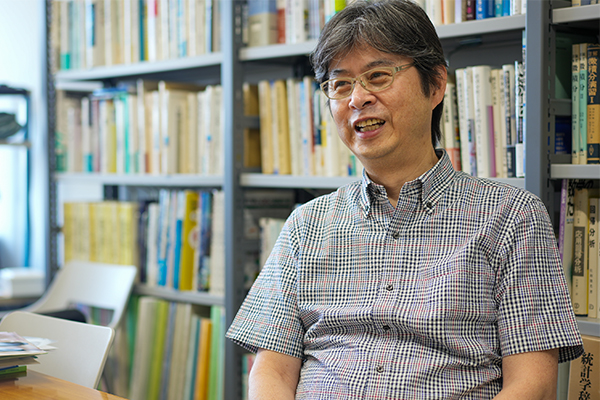
Professor Takashi Inoue

Graduated from the School of Natural Sciences (majoring in Mathematics) of the University of Tsukuba. Completed coursework for the doctoral program in Earth Sciences (majoring in Geography and Hydrology) at the University of Tsukuba Graduate School, but withdrew before obtaining a degree. Holds a PhD in Science. After serving as an assistant professor in the Department of Earth Sciences at the University of Tsukuba and an associate professor in the Faculty of Education at Akita University, he became an associate professor in College of Economics Aoyama Gakuin University in April 1995. He became a professor in the same faculty in April 2002 and General Manager in April 2024. He also became president of the Population Association of Japan in June of the same year. His areas of expertise are regional population theory, demography, GIS, and statistics. His recent publications include "Aging in the Tokyo Metropolitan Area," "Natural Disasters and Population," and "Gerontology as an Interdisciplinary Science" (all co-edited).

What exactly does your research topic, "Future Population Projections for Smaller Regions," entail?

My specialty is regional population theory within demography, and in recent years I have mainly been working on "future population projections for small areas." I started working on this research topic when I was asked to advise on future population projections for Tokyo in 2013. By "small areas," I mean narrowing the area down to the level of a specific town, block, or even a small district, but until now, population projections have almost always been done only at the municipal level. However, by narrowing the scope down to the town or district level even within the same city, it becomes possible to make more detailed future predictions, which has expanded the possibilities for application in various fields of regional policy.

So it can be used in concrete ways for urban development, right?

One concrete application example is infrastructure development planning. For instance, by focusing on developing sewage networks in areas where the population is projected to increase or remain relatively stable, local governments can efficiently advance their plans. Traditional population projections at the municipal level did not allow for such detailed analysis, but future population projections for smaller areas can be used as data to plan which areas should be developed.

It can also be used in school consolidation plans. Because it allows for predictions of future student populations in detailed areas, it becomes important data for considering how to place schools. In addition, it can be used in various regional policies such as countermeasures against tsunamis and floods, and the formulation of disaster prevention plans. I personally feel that future population projections for small areas have virtually limitless potential applications.

When did you begin serious research on "future population projections for small regions"?

As mentioned above, I began working on future population projections for small regions after taking on a project for the Tokyo Metropolitan Government, so that was about 12 or 13 years ago. Before that, I mainly focused on regional population theory, particularly the distribution of population and migration between regions. My focus on regions was largely influenced by the fact that my research foundation was in geography. As I mentioned in a previous AGU RESEARCH presentation, I have loved looking at demographic data and maps since childhood, and I was engrossed in them as a boy. On the other hand, I also developed a strong interest in mathematics in junior and senior high school, and I went on to study at the University of Tsukuba, School of Natural Sciences (at the time), where I could specialize in either mathematics or geography. During my undergraduate years, I diligently studied probability theory and statistics, but I began to feel the limitations of pure mathematics, so I decided to switch to population geography, which had been my interest since childhood, for graduate school.

So, after studying mathematics, you moved on to the study of population geography?

Population geography is a field within human geography that uses a relatively large number of mathematical formulas. Therefore, I found a way to utilize what I had learned and apply mathematics. Pure mathematics is not merely calculation; it is a field of study that includes philosophical elements, a world that cannot be fully explored without innate talent. In that respect, I thought that the field of population geography would offer an opportunity to demonstrate the mathematical thinking skills I had acquired.

At the University of Tsukuba, I had the opportunity to study not only mathematics but also geography from a scientific perspective. Thanks to this, I was able to arrive at the field of study that combines demography and mathematics, which I had been interested in since childhood, and I am still engaged in research there today. Looking back, I feel that all of my experiences have had a positive impact. Of course, the fact that I was able to successfully change my specialization is thanks to the guidance of the professors in the geography department during my graduate school days, especially my mentor, and I cannot thank them enough.

Could you tell me about the "Symphonica Statistical GIS Activity Encouragement Award" that you received this time?

This award was established in 2005, and I actually shared the first award with others for my work on "GIS education in university College of Economics." This is my second award, 19 years later. This award is given to individuals or organizations that have achieved outstanding results in activities related to "statistical GIS," which integrates geographic information systems (GIS) and statistical information. I believe that my series of studies on future population projections for small areas were recognized as fitting the purpose of this award.

As I mentioned earlier, the impetus for working on "future population projections by small area" came from a request for advice from the Tokyo Metropolitan Government regarding future population projections by small area. What I realized at that time was that there were hardly any rational methods developed for population projections at the small area level. I think that few people were working in this field because the projection results tend to be unstable when the regional unit is small, and the necessary population data was not sufficiently compiled.

How did you arrive at this new estimation method?

At the time, I was mainly analyzing the distribution and movement of regional populations, and I wasn't doing much work on population projections. However, once I realized there was no optimal theory, I thought, "Given my background in geography and mathematics, I should be able to do it."

The biggest challenge in estimations for small regions is that the estimated values fluctuate wildly. The methods considered so far have generally involved a simple process of truncating the fluctuations at a certain value. However, this treats extreme fluctuations and almost no fluctuations the same, resulting in inaccurate results. Therefore, I devised a method to smooth the parameters necessary for estimation and introduced a mathematical formula that enables more precise estimations.

Smoothing is a process used to suppress anomalous values in parameters required for future population projections that could lead to unusual results. This smoothing method utilizes the concept of population potential, a classical theory in geography. By formulating this mathematically and combining it with existing future population projection methods (such as the Hamilton-Perry method, known in Japan as the cohort change rate method), the projection results become more stable.

Population potential is defined by the principle that "the demographic influence of region B on region A is proportional to the population of region B and inversely proportional to the distance between regions A and B," thus defining the sum of the influences of surrounding regions on region A. This concept is a fundamental idea in geography, but it had never been applied to future population projections until now. Focusing on this point ultimately led to the development of a new projection method.

What were some of the challenges you faced during your research?

While the mathematical formula representing the new method was derived relatively smoothly after about a week of trial and error with paper and pencil, applying that formula to actual small-area population estimation proved challenging. The actual data obtained from local governments and other sources contained confidential information and many problems with temporal and spatial inconsistencies, which sometimes hindered calculations. To overcome these obstacles, we worked diligently with the company we commissioned to support our research, developing algorithms to estimate true values, and overcoming these hurdles. This ultimately took nearly a year.

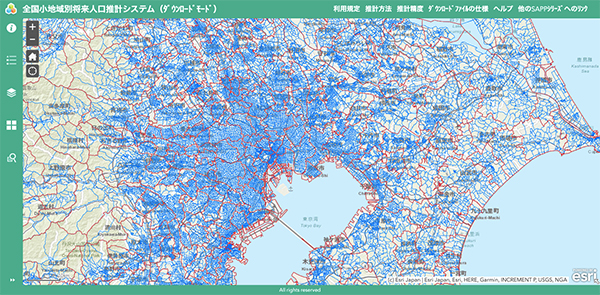
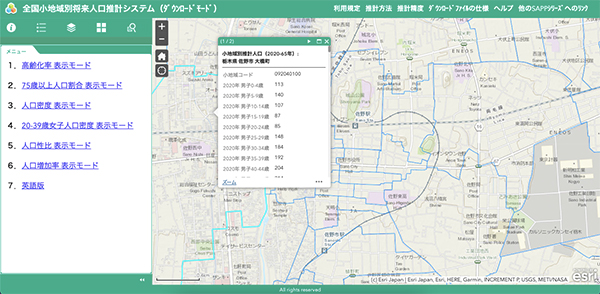
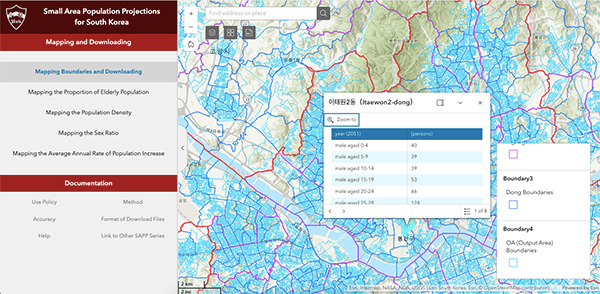
The resulting projection system was published online as the "National Small-Regional Population Projection System" (SAPP for Japan) and is used by many researchers and practitioners in local governments and other organizations. Furthermore, the research itself has been cited by researchers worldwide, and we have received invitations to speak at international academic conferences. In addition, based on these findings, we have built systems targeting the United States, Taiwan, South Korea, Australia, and other countries, and have published them as the "SAPP Series."

Please tell us about your future goals and any message you have for prospective students and university students.

I enjoy developing new indicators and methods using mathematical formulas, so I would like to continue doing innovative work related to regional populations. I am working on such work in parallel with future population projections for small areas, and the main ones are the "cohort cumulative net migration ratio," which represents the long-term trend of population migration by region using only census data, and the "re-migration index," which shows the probability that people in a given population group who have experienced migration once will migrate again. I would like to deepen these themes and continue my research. I am currently working at Aoyama Gakuin University, and I have been able to make a living here in "demography," which I would call my true calling. I feel that my life has truly been an experience of the saying, "If you believe, you can achieve it." If you have a strong desire, good mentors and supporters will naturally appear. Universities are the best places to create such an environment, so I would like to encourage all of you who are aiming to go to university to have a strong desire and take action to realize your dreams at Aoyama Gakuin University. I am confident that you will meet good mentors and supporters at this university.

Related Content

  • College of Economics, Department of Economics
  • Posted on 2023/06/26
  • Economic and quantitative analysis of the effects of carbon pricing
    - Proposing a balance between reducing carbon dioxide emissions and economic growth -
  • Professor Shigeru Matsumoto
  • Professor Shigeru Matsumoto and his research group, who conducted a detailed analysis of the impact of carbon pricing policies on household finances using microdata on consumption, were awarded the Achievement Award at the Ichimura Prize for Global Environmental Studies. The group was highly praised for their economic and quantitative analysis of the effectiveness and effects of carbon pricing policies, which have been noted as having been slower to take hold in Japanese society than in Western countries, and for proposing a method to achieve emissions reductions without significantly slowing down economic activity.

For inquiries regarding "research and industry-government-academia collaboration," please click here

Return to the list of "Topics Creating the Future"