AGU RESEARCH

Columns that reveal the world
- Getting up close and personal with the researchers -

In the world we live in,
From issues close to us to issues that affect all of humanity,
There are many different problems.
The current situation and truth that are surprisingly unknown,
Our proud faculty members offer interesting insights
We will reveal it.

  • School of Global Studies and Collaboration, Department of Global Studies and Collaboration
  • Published on 2026/04/30
  • As a member of the local community, we listen to people's voices and explore the possibilities of international cooperation.
  • Professor Masanobu Horie
  • School of Global Studies and Collaboration, Department of Global Studies and Collaboration
  • Published on 2026/04/30
  • As a member of the local community, we listen to people's voices and explore the possibilities of international cooperation.
  • Professor Masanobu Horie

Gaining "real-world information" by living alongside local residents in West Timor.

My area of specialization is international relations, and I incorporate fieldwork from a cultural anthropological perspective as my research methodology. My mentor during my master's program was a cultural anthropologist who also researched international cooperation. Since I was already specializing in international relations at the time, I thought that by approaching the subject from the opposite perspective to my mentor, we could complement each other's shortcomings. In other words, my current style is to combine the methodology of cultural anthropology with a foundation in international cooperation. That experience is the origin of my research today.


In my research, the most important thing is to "become an insider." During the long spring and summer breaks, I first become a part of the community I am studying. At that point, I am a blank slate, not knowing what problems exist. By living there and sharing in their daily lives, I discover small inconsistencies and casual questions. Then, I compare international discussions with the realities on the ground, ultimately connecting the two and systematizing the findings. Research is a long-term process, and unexpected situations are commonplace, but I don't view them negatively. Rather, I see them as excellent opportunities to encounter new discoveries.


My main research base is West Timor, Indonesia. East Timor became an independent nation and a member of ASEAN in October 2025, but West Timor remains Indonesian territory to this day. I conduct fieldwork in this place where two countries/regions coexist on a single island smaller than Kyushu. In one village in West Timor, people collect tamarind fruit and sell it to dealers as a source of income. In one case, I worked alongside a collector to investigate the process of converting the fruit into cash. The reputations among their peers and the realities of their work, as told in conversations with them, are "living information" that is often overlooked in evaluations of development projects. To hear these voices, it is necessary to sincerely build a relationship of mutual trust. Before listening to what the other person has to say, I make it a point to talk about myself first. One of the attractions of this research method is that I am making more friends in each country with whom I can share everyday topics. In Indonesia, I have a friend I have known for 40 years, with whom I have a close relationship that extends to their family. The relationships I have built through my activities are an invaluable asset to me.


East and West Timor, though sharing the same ethnicity and language, have been divided by a complex historical trajectory. Having experienced colonial rule and numerous wars and conflicts, they now face the refugee crisis. It is no exaggeration to say that the challenges of international politics are concentrated in this region. On this small island, which has been at the mercy of international trends, there are voices of residents that have not been adequately heard until now. The ideal of the SDGs is "leaving no one behind," but what about "those who have already been left behind"? They are, in a sense, starting from a disadvantage, and although some kind of consideration is needed, reality has not always been that way. Not only in West Timor, but also in countries and people like Sudan and Yemen, who tend to be overlooked, we want to continue exploring the possibility of bringing the light of international cooperation to them in some form.
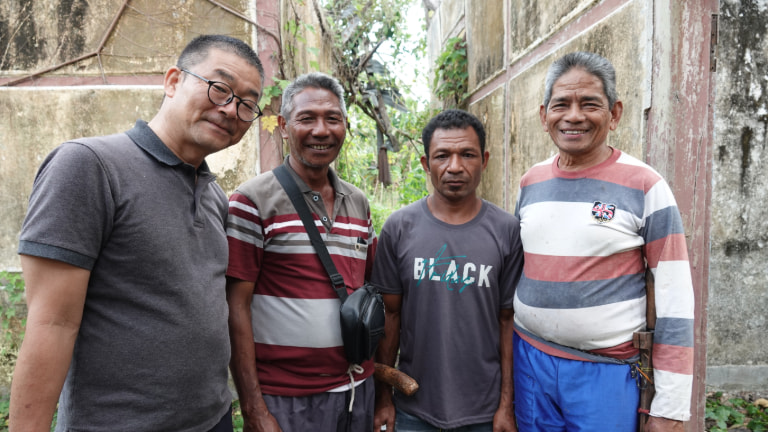
In the village where my research base is located, a place I've been visiting for over 20 years. With friends I've known for a long time.

Potential for international cooperation utilizing local Chinese networks

Until 2005, I worked for a major general contractor, but an unexpected assignment in Bangkok, Thailand, where I was involved in ODA-related infrastructure development projects, captivated me with the field of international cooperation, leading me to change careers and become a UN staff member. Bangkok also houses the Asian headquarters of many UN agencies, including the UN Economic and Social Commission for Asia and the Pacific, giving me many opportunities to interact with UN staff members both professionally and personally. I was deeply impressed by how they formed teams with people of completely different nationalities to work towards solving a single problem, and before I knew it, I wanted to challenge myself and become a UN staff member. My first assignment as a UN staff member was in West Timor, and after that I worked in Sudan, the Philippines, Yemen, and Afghanistan. Although my work as a UN staff member was fulfilling, I also faced the harsh realities of international humanitarian aid. Unlike my time at the general contractor, where work proceeded according to plan, things often did not progress as expected. Realizing my own lack of skills, I decided to study at graduate school while working to improve my expertise.


It was there that I met my mentor, the cultural anthropologist I mentioned earlier, but at the time I had no intention of pursuing a career in academia. Studying in graduate school while working meant that research time was limited to after working hours, and I had to work under time constraints. I also dedicated all of the vacation time given to UN staff working in places with harsh working conditions to my research, and I managed to balance both with my work because I wanted to enhance my expertise and contribute to the local community. However, having research cases right in front of me meant I was in a very fortunate environment, and I also made many friends through fieldwork, gaining more than just research itself. In the end, I completed my doctoral program while continuing to work.


My decision to pursue a research career a few years later stemmed from confronting the reality that Japan's international standing is shifting away from that of a "country that only gives," and from feeling the need to share this change with the younger generation. Furthermore, a growing interest in understanding "Japan in the world" from multiple perspectives was also a major motivation.


Recent research focuses on the Chinese community in West Timor (descendants of people who immigrated from what is now China). The tamarind collector mentioned in the previous episode was also of Chinese descent. They immigrated from China during the Dutch colonial era and played an important role primarily as merchants and distributors. While there have been anti-Chinese movements and riots throughout history, there are currently no significant social problems. West Timor is closely linked to the economic sphere of Surabaya, Indonesia's second-largest city, and this connection is a network built by the Chinese community over many years, while they have come to terms with various issues. In the process of building new supply chains for international cooperation, divisions tend to arise between those who benefit from aid and those who do not, and social friction is unavoidable. Therefore, shouldn't we consider ways to make better use of the local Chinese networks that have functioned in the region for many years? While the Chinese community is subject to various perceptions, we hope that utilizing the Chinese network will lead to more beneficial and equitable development methods for local societies, and that we can also clarify some of the social and economic roles they have played in rural areas.

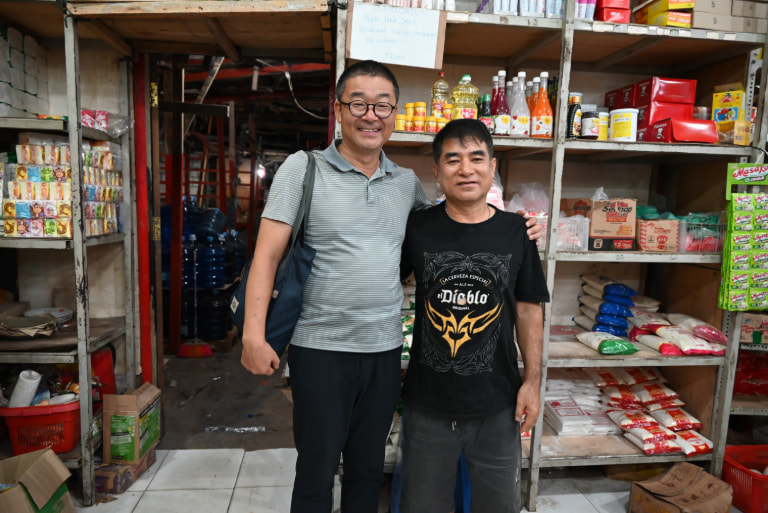
With a Chinese friend who runs a household goods wholesale business in town


Understanding each other as fellow human beings, transcending ethnic and religious barriers.

Previously, one of my seminar students conducted fieldwork in Malaysia for four months. Malaysia is a multicultural nation where diverse ethnic groups, including Malays, Chinese, and Indians, coexist. It's often said that there's a cultural concept called "positive indifference," where people refrain from deeply interfering with each other to avoid conflict. However, the student, who lived there and interviewed many residents, concluded that "it's not indifference at all; rather, a sense of mutual recognition and respect functions within the society." Even if ethnicities, religions, and lifestyles differ, ultimately, what matters is the individual human being and their personality, and the most important thing is the willingness to understand others.


My area of expertise, international relations, primarily focuses on states and international organizations as the main actors in our research. However, in my seminar, we focus on the daily lives of ordinary citizens. Many people in Japan are affected by global events, and there are plenty of research topics to explore. One student in my seminar conducted fieldwork in a Kurdish community in Kawaguchi City, Saitama Prefecture, grappling with the question of whether Japan should accept more foreigners or not. I believe that what I felt during my fieldwork in Indonesia and what my students experienced during their fieldwork in Malaysia and Japan are probably the same: they are realizing anew that "we are all the same human beings." In addition to research, our seminar also involves various volunteer activities, and through encounters and interactions in the field, students experience firsthand the importance of building human relationships.


School of Global Studies and Collaboration welcomes students who wish to focus on the realities of people in diverse environments both domestically and internationally, and to find questions arising from those experiences. A vague sense of purpose is perfectly acceptable as a starting point. Please cherish your spirit of inquiry as you progress through these four years. If you do so, each learning experience at university will connect in unexpected ways, eventually bearing fruit as a tangible record.

Related articles

New Theory of International Cooperation [3rd Edition] 
New Theory of International Cooperation [3rd Edition]


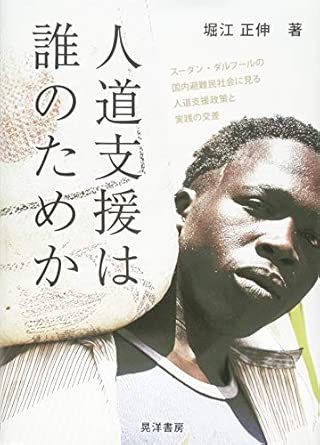
For whom does humanitarian aid benefit? 
For Whom Does Humanitarian Aid Serve? – The Intersection of Humanitarian Aid Policies and Practices in the Internally Displaced Persons Community of Darfur, Sudan –

  • School of Global Studies and Collaboration, Department of Global Studies and Collaboration
  • Professor Masanobu Horie
Link to researcher information

Related Keywords

Related Content

  • 経済学部
  • 数十年先の人口分布を町丁・字単位で予測し
    都市計画や防災計画の
    基礎となるデータを提供する
  • 井上 孝 教授
  • 人口構造の変化を長期的に見通すことは、国や自治体の政策立案において欠かせない。人口減少に拍車がかかる日本ではなおさらだ。しかし、詳細な人口推計は技術的な壁により、困難を極めた。推計エリアが狭いほど生じる数値の「ぶれ」をいかに抑えるか。井上教授はある古典的な理論を応用して画期的な方程式を編み出し、全国小地域別将来人口推計を実現させた。本コラムでは研究者の人となりに迫りながら、新手法の内容を解説する。 (2021年掲載)

  • Faculty of Education and Human Sciences
  • The key to revitalizing the region lies in "high schools"
  • Professor Daijiro Hida
  • In recent years, the debate over regional revitalization has become heated due to concerns that the functions of communities will shrink due to population decline, and there is a demand to build an "autonomous decentralized society (a society in which each region becomes independent by utilizing its own characteristics and finds its own way of development)" as a measure for regional revitalization. In this column, we focus on high school education in regional areas in building an autonomous decentralized society, and use the example of a project to make high schools more attractive in remote islands and mountainous areas of Shimane Prefecture to argue that high school education holds the key to regional revitalization, and further explore the potential that education holds in regional revitalization.

  • 総合文化政策学部
  • サウンドスケープから都市の実態を探ろう!
  • 鳥越 けい子 教授
  • 音を意味する「サウンド」と、景色・景観を意味する「スケープ」との複合語である「サウンドスケープ」は、音の世界から風景を捉え、その環境を文化の問題として扱う考え方である。音を聴くことを大切にするだけではなく、形に縛られない土地の記憶や来歴など、視覚のみならず、場所の気配や雰囲気も含めた環境の本質を捉えようとするものである。本コラムでは、サウンドスケープとは何かを説くと同時に、その考え方を通して土地の文化や歴史を大切にした環境計画につながる「新たなまちづくり」の事例を紹介しながら、サウンドスケープというコンセプトの意義を語る。(2016年掲載)

Related Content

  • コミュニティ人間科学部
  • 博物館の存在意義とは。
    人・歴史・背景から読み解く
  • 大木 真徳(おおき まさのり) 准教授

  • School of Global Studies and Collaboration, Department of Global Studies and Collaboration
  • Mexico's economy falls into the "middle-income trap."
    We will consider the regional disparities and poverty issues.
  • Associate Professor Kaoko Sakikawa

  • 総合文化政策学部
  • サウンドスケープから都市の実態を探ろう!
  • 鳥越 けい子 教授