Aoyama Gakuin University faculty members:
He is an uncompromising researcher.
Aiming for a prosperous society,
We are always conducting cutting-edge research.
We will explore the research results of our faculty members who are shaping the future.
TOPIC
The Imperial Edict states, "The Emperor shall be the symbol of the State and of the unity of the people, deriving his position from the will of the people with whom resides sovereign power." This stipulates that in Japan, sovereignty resides with the people, and the Emperor's position is that of a "symbol."
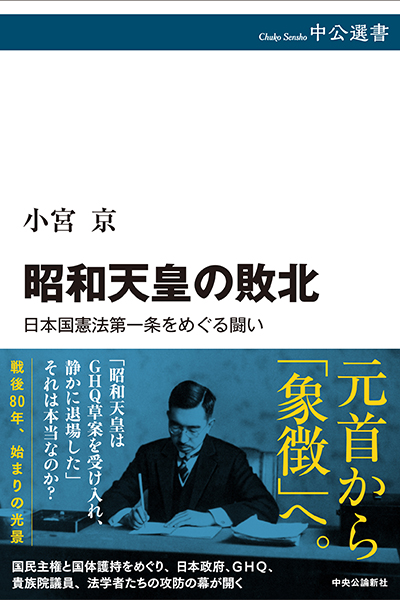
Book Highlights
The prevailing view has been that the constitution, based on the GHQ draft, was established through a "third sacred decision" in which Emperor Showa accepted his role as a "symbol." However, in reality, no such "sacred decision" existed, and Emperor Showa himself was reluctant to accept the symbolic monarchy. Perhaps accepting this position was a "defeat" for him. This book unravels this new perspective based on a vast amount of historical material.
Explore the topic with your teacher
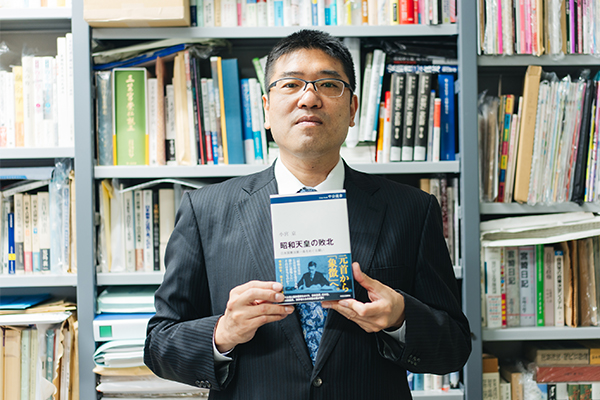
Professor Kyo Komiya
The University of Tokyo Faculty of Law B.A., Class III. M.A. in Political Science, Graduate School of Law and Politics, The University of Tokyo; Ph. D. in Law. After working as an assistant professor at the Department of Original Materials, Center for the History of Modern Japanese Law and Politics, Graduate School of Law and Politics, the University of Tokyo, and as a full-time lecturer and associate professor at the Department of Law, Momoyama Gakuin University Faculty of Law, he was appointed associate professor at Aoyama Gakuin University College of Literature Department of History in April 2014, and will assume his current position in April 2020. He specializes in contemporary Japanese history, political history, and political science. He is the author of "The Birth of the Liberal Democratic Party: The Public Election of the President and the Theory of Organized Political Parties" (Kotakusha) and "Untold Occupied Japan: From the Exile from Public Office to the 'Conservative Mainstream'" (NHK Books).
The impetus for this project dates back to the time of the COVID-19 pandemic. At the request of the House of Councillors Secretariat, the "House of Councillors Secretariat Constitutional Documents Research Group" was established, headed by Professor Kazuyuki Kobayashi, Dean of the College of Literature. This group gained the opportunity to investigate historical materials from the Imperial Diet era, particularly those held by the House of Councillors, which are normally not open to the public. While administrative documents are stipulated to be transferred to the National Archives of Japan and made public after a certain retention period, the legislature is not obligated to do so, and as a result, the actual state of past debates remains largely unknown. Against this backdrop, this research group had the opportunity to access valuable documents, and their encounter with unexpected historical materials led to the writing of this book, "The Defeat of Emperor Showa: The Struggle Surrounding Article 1 of the Japanese Constitution."
That's right. As I read through the historical documents, previously unknown facts came to light one after another, and I was surprised many times by the information I encountered for the first time. For example, on page 107 of the book, in the record of the "Consultative Meeting of Volunteers from Both Houses of Parliament," there is a statement that says, "His Majesty wishes to be King in Parliament, so we should take it there," and this phrase greatly shocked me. Until then, it had been believed that Emperor Showa had expressed his acceptance of the GHQ draft that formed the basis of Article 1 of the current Japanese Constitution, "The Emperor shall be the symbol of the State and of the unity of the people (omitted)," at an early stage, and I had never heard of him expressing any other specific opinions. However, the historical documents clearly stated that he "wishes to be King in Parliament." As explained in more detail in the book, "King in Parliament" envisions a form of imperial family that is different from the current popular sovereignty or complete monarchical sovereignty, based on the system of the British monarchy, and in other words, it contradicts the common belief that he readily accepted "the symbol of the State and of the unity of the people." That's when I felt, "This must be an extremely important historical document," and that became the starting point for this research. In short, it didn't start with a clear motivation or concept; rather, I stumbled upon a historical document and discovered a description that seemed historically extremely important, which made me feel it had research significance, and that's how I deepened my research. This way of conducting research is the same for other topics as well. Rather than deciding on a theme in advance and proceeding systematically, I often become interested in a document that I happen to come across or a primary source introduced in exchanges between researchers, and from there, the theme gradually takes shape.
As I was gradually putting my findings into writing, I consulted with an editor I knew. I thought the content was interesting, so we explored how it could be published. As we shared the content, the editor pointed out that "there are many characters and it's complex" and "there are many technical terms, making it a little difficult to understand." Because specialized concepts like "King in Parliament" appear, it became necessary to provide more detailed explanations. We went back and forth, suggesting things like "let's add some supplementary information here" and "we should include this historical document," and the volume gradually increased. Ultimately, we decided that "it would be better to publish it as a book in the Chuko Sensho series," and that's how it came to be in its current form.

That's exactly right. I myself have specialized in postwar history, but I haven't seriously researched the process of the establishment of the Japanese Constitution itself. So, as I read through the historical materials, I was constantly pondering, "What does this mean?" I sometimes encountered content that differed from the previously accepted view, and each time I had to carefully reread the historical materials in search of the answer. This book is structured to allow readers to relive the trajectory of my own inquiry, so to speak, as I encountered these "mysteries" and tried to unravel them. Of course, I have made adjustments to the structure and explanations with readability in mind, but basically, I have put into writing exactly what I went through as I stopped to ponder each question. Therefore, I think readers will be able to follow along with me and see "what the author struggled with at each point and what clues he used to find his way."

What struck me was the lack of researchers of my generation or slightly older who were studying this field. The GHQ documents were released in the United States in the 1970s, and apparently, many researchers in Japan, the US, and elsewhere showed great interest and excitement at the time. For those of us who experienced the immediate post-war period firsthand, these documents must have been truly "living information." However, about 50 years have passed since then, and while those who experienced that time have retired, the number of young researchers has not increased much. In this situation, when I participate in research meetings, people are sometimes surprised and say, "Mr. Komiya, you're so young," which made me acutely aware of the generational gap.
Furthermore, when I discuss my research findings with older generations, they are often surprised. In particular, many are still operating under the traditional understanding that Emperor Showa accepted the symbolic monarchy through a "sacred decision," and sometimes they react with a questioning "Huh?" to my points. However, I have simply put into words the possibility that it cannot be definitively said that Emperor Showa voluntarily accepted that position, as a result of carefully verifying historical materials. I had no intention of overturning conventional wisdom or making any special claims. The image of history that emerged as I confronted the historical materials before me naturally differed from conventional understanding. I feel that encountering such gaps is both the joy and the difficulty of studying history.
Such gaps may stem from a one-sided perspective. This book was initiated by examining historical materials from the House of Peers, a branch of the legislature, but historical accounts have tended to focus primarily on the House of Representatives. In modern times, when we think of parliamentary deliberations, we inevitably focus on the House of Representatives, and this was also the case before the war. In research on the legislature, research on the House of Representatives has always taken the lead, with research on the House of Peers catching up 10 to 20 years later.

This research deliberately stepped beyond existing perspectives and challenged the idea of how a different image and history could be depicted if we viewed things from the perspective of the House of Peers. I believe there are instances where a gap has emerged between the historical image that society has taken for granted and the newly depicted history. I think that making the most of the available historical materials and re-examining history from a different angle than existing understanding is extremely important in clarifying the contours of history and deepening a multifaceted understanding.
Actually, during my student days, I aspired to become a civil servant, passed the exam, and even progressed to the stage of visiting government offices. However, in that process, I began to reconsider what I truly wanted to do, and ultimately decided to choose a different path. On the other hand, I had always had a strong interest in history, and the lectures on Japanese political and diplomatic history that I was taking at the time were very appealing, so I thought, "I would like to deepen my research in this field," and decided to pursue a career as a researcher. In particular, my research focuses on post-war politics, and especially modern and contemporary political history, with politicians represented by Ichiro Hatoyama being a central focus.
In my research lab, we work not only on politics but also on media studies focusing on contemporary magazines such as "Nico☆Puchi" and "AB-ROAD." In these areas, we can hear directly from those involved and often realize that what is considered common knowledge is actually not the case. Precisely because it is a field where systematic research is not yet sufficiently advanced, there is a great possibility of becoming a pioneer in the field. I try to convey to my students that this is a field that offers intellectual stimulation and the thrill of discovery.
In the future, I would like to undertake research to clarify the actual state of Emperor Showa's awareness of and involvement in postwar politics. I believe that examining the relationship between the Emperor and politics can provide an important perspective for reconsidering contemporary Japanese political culture.