Aoyama Gakuin University faculty members:
He is an uncompromising researcher.
Aiming for a prosperous society,
We are always conducting cutting-edge research.
We will explore the research results of our faculty members who are shaping the future.
Why is it necessary to detect "accounting fraud risk" in advance?
Accounting fraud has serious consequences for investors, employees, business partners, and the entire capital market. If warning signs of fraud can be detected, damage can be prevented, for example, by changing the focus of audits. Therefore, in recent years, research into analyzing corporate disclosure documents to detect signs of fraud has been attracting global attention.
Key points of the collaborative research
This research is a joint project with KPMG AZSA LLC. By combining the theoretical and data analysis expertise of researchers with the experience and intuition of frontline audit practitioners, we aim to build a "practically usable fraud risk detection model."

Explore the topic with your teacher

Professor Kenichi Yazawa
Graduated from Kokugakuin University College of Economics. D. in Business Administration and Accounting, Graduate School of Commerce, Hitotsubashi University. D. in Commerce. Aoyama Gakuin University School of Business Full-time lecturer since 2005, associate professor in 2009, and visiting professor at the University of New South Wales (UNSW) before assuming his current position in 2017. He specializes in empirical analysis of accounting, auditing, and governance, and textual analysis of financial reporting.
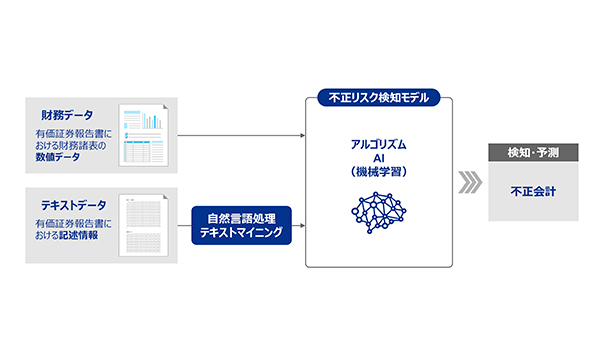
We are researching a system to detect accounting fraud risks from information contained in financial reports. Specifically, we have built a system that combines financial data and text data from securities reports and evaluates risk using machine learning. As a result of training with 36 financial variables and 104 linguistic variables, we were able to achieve higher accuracy than conventional models that use only financial data. Furthermore, we found that accuracy improved even further by adding the "tone of the text (positive/negative)" determined by the generating AI as a variable. This suggests that signs of fraud can also appear in Japanese text data. In addition, the analysis revealed that characteristics of fraudulent companies include a generally negative "MD&A (Analysis of Financial Condition, etc.)" with few ratio expressions, a positive "risks of business, etc." with many references to third parties, and a simple and abstract description of "corporate governance." This has deepened our understanding of how (or why) fraudulent companies write (or don't write) reports.

I actually started relatively recently, around 2019. I had no prior programming experience, so I started by setting up a Python environment. Fortunately, the late 2010s was an excellent time to begin research. There were three trends for this reason: ① increased awareness of preventing accounting fraud from around 2005, ② the advancement of big data in financial reporting from around 2010, and ③ the spread of text mining and machine learning technologies from around 2015, which led to an increase in related papers. Fueled by this background, I was able to continue studying and learn to write code, which brings me to where I am today. I continue to learn along with the development of the "accounting x AI" field.
The advantage of machine learning lies in its scalability, which, unlike traditional statistical research, allows for the incorporation of a wide variety of variables with virtually no limitations. Therefore, I am particularly focused on areas where diverse variables can lead to fraud detection.
Rather than saying "the resolution has increased," it might be more accurate to say "we can now see things from a different angle than before." In traditional statistical analysis, setting hypotheses beforehand is crucial, but in machine learning, you can input variables even without hypotheses, and sometimes unexpected effective variables are discovered from this. In overseas research, it has been reported that in the process of investigating the reasons why a particular variable is effective, features that humans had not noticed often come to light.
Yes. The distinguishing feature of this research lies in its combination of "accounting data" and "text data," but because natural language processing is predominantly in English-speaking countries, its application to other languages tends to lag behind. At the time, there were few studies using Japanese data, so our research is considered pioneering. In fact, there were difficulties in designing variables differently from those used overseas. For example, "readability," which indicates how easy a text is to read, is measured in English by word length and syllable count, but this cannot be applied to Japanese. Therefore, we incorporated indicators from research in other fields and have been exploring Japanese-specific readability indicators through trial and error.

That's right. Combining methods from different fields, such as finance or language education indicators (like obfuscation) with accounting, expands the possibilities. For this reason, we are constantly exchanging opinions and gathering information with various experts. In collaborative research, dialogue with practitioners' on-the-ground experiences is also important. We discuss whether the variables identified by AI align with the on-the-ground experience of auditing and what they mean. If we can create a highly accurate and practical model, it will be useful for auditing practice and investors' decision-making. This kind of interdisciplinary research is very exciting.
Yes. Generative AI excels at contextual interpretation and can deeply evaluate and interpret the nuances (positive/negative, etc.) of complex financial documents. This gives us confidence that we can improve conventional metrics without building complex models, and we are currently researching how to integrate it into our models.
Even more interesting are the insights gained from collaborative research with auditing experts. When experts input their "hard-to-articulate sense of unease" as prompts, the AI provides hints for judgment from that perspective. We believe that AI is not merely "artificial intelligence," but "Augmented Intelligence," which extends human capabilities. By effectively utilizing this technology, we may be able to see the "humanity" behind those who commit fraud.
My goal is to create systems that benefit society and to nurture the next generation of students. Because accounting fraud affects the entire market, I hope that our research findings will support decision-making in actual audits and corporate analysis. To that end, we will expand the scope of our analysis to include IR materials and social media, and we will also focus on improving the interpretability of our results so that people can understand "why the risk is high." This is because for our findings to be usable in the field, it is important not only that they "get right," but also that they "lead to the next action." I also want to utilize the research process in education. Last year, we invited representatives from Azusa Audit Corporation to give lectures and held a special three-way discussion. Connecting research, society, and education is my biggest goal.

This research is in the field of "accounting x AI," a field that transcends the boundaries between humanities and sciences. In the coming era, there will be fewer jobs that can be completed with only a single specialty. Aoyama Gakuin University offers opportunities to learn while connecting with society through dialogue with companies and auditing firms. We encourage you to "multiply" your intellectual curiosity and challenge yourself in a new field. Research is not just about writing papers; it is about creating the future of society and yourself. We would be delighted if you could take that first step here.
There are no related items yet.