AGU RESEARCH

Topics that shape the future
- Closer look at research results -

Aoyama Gakuin University faculty members:
He is an uncompromising researcher.
Aiming for a prosperous society,
We are always conducting cutting-edge research.
We will explore the research results of our faculty members who are shaping the future.

  • School of Business, Department of Marketing
  • Published on 2026/06/19
  • Why do people feel attached to brands? — Unraveling the essence of "brand relationships"
  • Professor Susumu Kubota
  • School of Business, Department of Marketing
  • Published on 2026/06/19
  • Why do people feel attached to brands? — Unraveling the essence of "brand relationships"
  • Professor Susumu Kubota

TOPIC

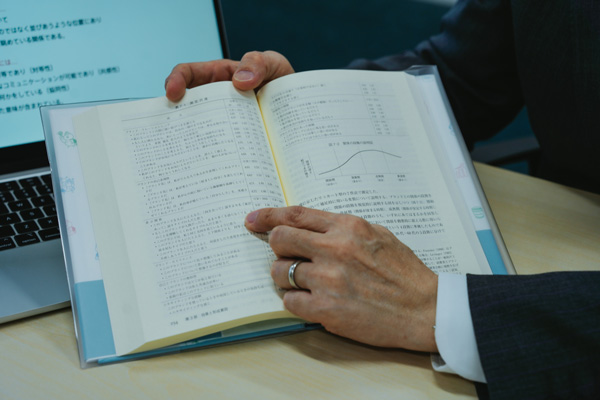
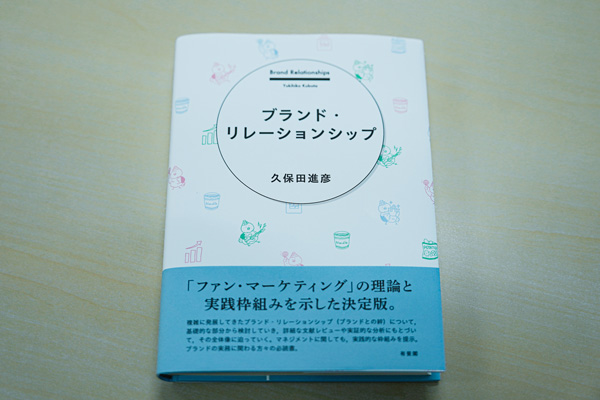
Professor Nobuhiko Kubota's book "Brand Relationships," which summarizes the results of his long-term research, has been highly praised in various fields and has received awards from multiple academic societies.

Numerous awards

Professor Kubota's book "Brand Relationships," which systematically summarizes his research to date, was published in August 2024 and has since received extremely high praise from various quarters, starting with the "Academic Award (Excellent Award in the Book Category)" from the Japan Society of Commercial Science in June 2025, followed by the "Japan Marketing Book Award 2025 (Runner-up)" from the Japan Marketing Association, and the "Academic Award (Academic Book Category)" from the Japan Advertising Association.

Award-winning points

This book meticulously organizes the concept of brand relationships, presenting a scientifically sound analysis of the relationship between consumers and brands, while also proposing a concrete framework for management. Furthermore, the extensive empirical research presented in this book not only contributes to the advancement of brand and marketing research, but also offers valuable insights to companies engaged in various strategies, including fan marketing. (Excerpt from the recommendation for the Japan Marketing Book Award 2025)


Illustration: Arrow

Explore the topic with your teacher

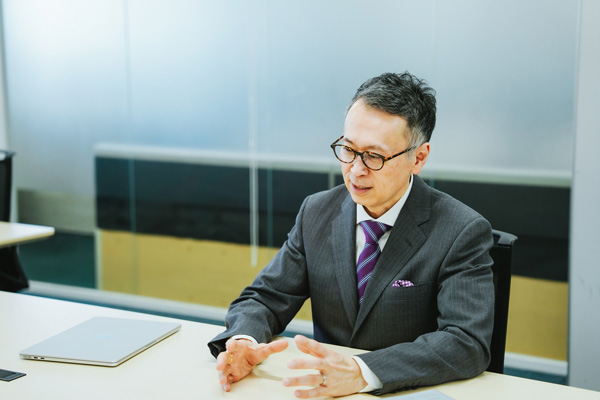
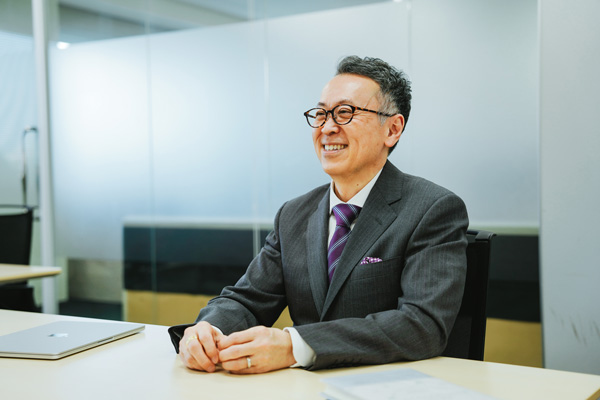
Professor Nobuhiko Kubota

Graduated from Meiji Gakuin University College of Economics.After working at Sanrio Co., Ltd., he entered the Graduate School of Commerce at Waseda University. He completed the master’s program there and withdrew from the doctoral program after earning the required credits. He holds a Ph.D. in Commerce. After teaching at the Faculty of Commerce at Chukyo University, the Faculty of Comprehensive Policy Studies at the same university, and Toyo University School of Business, he was appointed professor at Aoyama Gakuin University School of Business Department of Marketing in 2013.His areas of expertise include marketing, brand management, and marketing communications. His publications include *Brand Relationships*, *Relationship Marketing*, *Introduction to Marketing* (all published by Yuhikaku), and *What Is Liquid Consumption?* (Shinchosha).

First, what exactly is your research topic, "brand relationships"?

In short, it's the emotional connection we consumers feel with a brand. We could describe it as "affection for the brand," or, perhaps a little more dramatically, as a "bond with the brand." It's also fair to think of it as the fan mentality we have for our favorite brands.

Why did you become interested in this topic in the first place?

My initial experience that sparked my interest in this research topic was when I was working for a private company that dealt in character-based businesses after graduating from university. At the time, there were many Mac users in the creative industry, and fans would applaud and cheer at Apple's new product announcements. A junior colleague of mine, who was watching this, wondered, "Why are these people so happy?" That struck me. I thought, "It is indeed strange to be so excited about a company announcing a new product, as if it were your own." I wondered why such a psychology arose when surrounded by people who felt an attachment to Macs.

There's another experience I'll never forget. It happened when I was a new employee undergoing store training. That day, a certain product was out of stock in the store. Normally, in such cases, we would process it as an "inter-store transfer," and have the product delivered from another store. However, one of the senior employees raised his hand and said, "Tomorrow, I'll leave home an hour earlier, pick it up at store XX, and then come to work." His reasoning was, "That way, the product can be delivered sooner, which will make the children (our customers) happy and make them like our store even more." Looking back now, I realize this was an action based on the psychology of organizational commitment, but at the time, I was shocked by this offer, which seemed like self-sacrifice, and wondered, "Why would he go that far...?"

These two experiences led me to wonder, "What exactly is the attachment that people feel towards organizations and brands?" This question became the starting point of my research.

What are the key characteristics of your approach to "brand relationships"?

I define brand relationships as "a positive and lasting psychological connection that develops between oneself and a brand." The psychological connection between brands and consumers began to attract attention in academia in the late 1990s, and many papers have been published on the subject. However, at that time, much of the research viewed brands as "tools for self-affirmation and self-expression," such as "brands that help us feel like we are who we are." While I was interested in such research myself, I also felt it was somewhat lacking. This is because I believed that attachment to a brand involves more than just self-affirmation and self-expression; it also involves deeper, more internal psychological aspects.

Therefore, in my research, I decided to examine brand relationships—that is, the psychological connection between brands and consumers—from two perspectives. One is the "brand as a tool" for self-affirmation. The other is the "brand as a partner" that is there for you like a friend. I believe that the integrated treatment of these two aspects is a characteristic and original feature of my research.

What exactly are brands as a means of "self-expression" and brands as a "partner"?

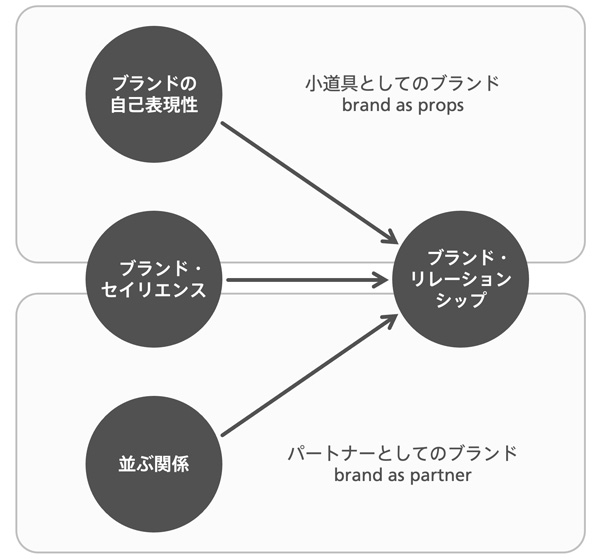
In English, the word for "prop" is "prop." "Prop" is an abbreviation of "property." Therefore, we have named brands that serve as props for self-expression "property-type brands." On the other hand, we have decided to call brands that are like friends "partner-type brands." Combining these two concepts, we have developed the "Property Partner Model" to explain why brand relationships are formed. In this model, three factors are assumed to be involved in the formation of brand relationships: "the self-expressiveness of the brand," "brand salience," and "the relationship of being on equal footing."

"Brand self-expression" is a concept that indicates the degree to which a brand is suitable for expressing one's real or ideal self. "Brand salience," on the other hand, refers to how easily a brand comes to mind in various situations and environments. It could be described as its presence in the mind. Attachment to a brand that lacks presence cannot be formed.

And then there's the "side-by-side relationship," which is a very interesting element. It's a concept proposed by psychologist Professor Yoko Yamada (Professor Emeritus of Kyoto University) that shows the basic structure of a happy two-person relationship. Professor Yamada asked more than 1,500 university students to freely draw pictures of "their relationship with their mother when they were children," and then analyzed them. As a result, the pictures drawn by university students who had a happy and ideal relationship with their mothers were all very similar. The overwhelming majority of the pictures showed the mother and child "standing side by side." I realized that this "side-by-side relationship" also applies to the deep attachment people have to a particular brand, and I positioned it as one of the factors in the formation of brand relationships.
The resulting "property partner model" was then analyzed through repeated consumer research, revealing that while "brand self-expression" sometimes plays a central role, in other cases, a "parallel relationship" is central to building a partnership.

Brand Relationship Property Partner Model (Core Model)

How does your research proceed, Professor?

The basic flow is: Idea (inspiration) → Hypothesis building → Research → Analysis →
The process is as follows: writing a thesis. However, even an initial flash of inspiration or an idea that comes to mind doesn't immediately lead to academic logic. In my case, I draw diagrams and notes in a notebook, "let them sit" for a few days, then look at them again after a while and think about them again. I repeat this process many times. When I look back at the diagrams and notes of my initial ideas a few days later, I notice various things, such as "This is interesting" or "These two points don't connect." In fact, I learned the technique of discerning the quality of an idea by "letting it sit" from a designer friend of mine when I was working at a character business company. He later designed the cover for one of my books. Now I'm a professor at an art university, and it's true that having friends is a wonderful thing.

Furthermore, I was able to utilize the university's special research period program for my research on brand relationships. I am truly grateful to Aoyama Gakuin University for providing me with an environment where I could immerse myself in research for a year without attending classes. I went to the lab every day, spending time from morning till night thinking, reviewing, and thinking again. By relentlessly repeating this cycle of moving forward and going back, I was able to deepen my understanding of the logic.

What does brand relationship mean for a company?

Brand relationships are not a "magic wand" that can instantly create a buzz on social media. Companies need to think about what kind of brand they want to build, rather than engaging in superficial activities, and take the time to slowly build good relationships with their fans. Whether it's a property-based or partnership-based model, building a brand that is accepted by consumers requires not betraying customers and building long-term trust and affection. I believe that how much time you spend building trust will be crucial for brands going forward.

So, this isn't something that will immediately lead to increased sales for businesses, is it?

Brand relationships enhance a company's competitive advantage and generate high profits. In that sense, I believe my research is attractive to companies. However, we university researchers are different from consultants who solve problems at the request of companies. Our important role is to consider how to improve society as a whole. It could be said that the mission of management scholars is to find ways for companies' activities to become more effective and efficient, and thereby make consumers happier.

I have a journalist friend who produces news programs for NHK, and he is motivated by a desire to "uncover the truth." Similarly, we researchers also have a strong desire to "unravel the truth" at the heart of our research. It is not the job of a university researcher to deliver information convenient for corporations or to provide convenient methods. Rather, the role of a researcher is to prevent misleading marketing that deceives consumers and to show society how better relationships between brands and consumers can be built. This book is also written based on that idea.

The book "Brand Relationships" systematically compiles over 15 years of research. What are the advantages of working on a single theme over such a long period?

In the past, what was important for researchers was writing "books." However, this is now shifting towards writing "papers." Instead of spending time compiling a single book, the emphasis has shifted to publishing research findings quickly. I think this is natural considering the societal changes symbolized by digitalization. It's similar to how the way we listen to music has changed from "albums" in the CD era to "songs" in the streaming era. I believe that both "books" and "papers" have their own merits. And I think that "books" have the advantage of being able to construct a systematic and comprehensive argument by combining multiple research findings. This is similar to how "albums" are more effective than "songs" in conveying an artist's thoughts and worldview.

Finally, do you have a message for high school students who will be studying at university?

When I left my job to become a graduate student and conduct research, my mentor and supervising professor told me, "Researchers must have a grand theme. It must be immediately clear to others what kind of research you do." Now, I convey this to young people using the phrase, "create a constellation."
When you look at the night sky, you can see many stars. And when stars combine, they form constellations. But constellations only appear because the stars are far apart. It is precisely because the stars are far apart that shapes are created. If the stars were clustered together in the same place, they wouldn't form constellations. So what if the stars were extremely far apart? If they were too far apart, they still wouldn't form constellations.

Isn't the same true for our activities? Instead of repeating the same thing over and over, by gradually shifting our themes, we can make a bigger statement. However, if we tackle themes that are too far apart, it becomes difficult to come together as a cohesive whole. If we want to create a magnificent constellation, we need to place new stars in places that are not too far apart. We need to be creative so that the stars appear to come together as a whole. Of course, it is very important to have various experiences and gain various kinds of knowledge. Especially when you are young, it is important to learn broadly. On top of that, by continuing to learn with your own core values, these things will eventually connect and become of great meaning and value to you. I hope you will take one step at a time and build your own learning in your own way.

*The affiliations, Position, and research topics of the individuals listed are as follows:
This information is generally based on the time of the interview.

Related Content

  • School of Business, Department of Business Administration
  • Published on 2026/02/26
  • Using accounting and AI to spot "suspicious companies"—a study deciphering signs of fraud hidden in the "writing style" of documents.
  • Professor Kenichi Yazawa
  • Accounting fraud has a serious impact on the entire capital market, but if the early signs of fraud can be detected, the damage can be prevented. In recent years, research that analyzes corporate disclosure documents to find signs of fraud has attracted global attention. Professor Kenichi Yazawa, in collaboration with KPMG AZSA LLC, is developing an AI model that uses AI (machine learning and natural language processing) to detect early signs of accounting fraud by focusing on both the numbers (financial data) and text (text data) in the securities reports published by companies.

  • School of Business, Department of Business Administration
  • Published on 2026/07/02
  • How are "learning teams" created? – Transformational leadership and communities of practice that overcome knowledge-sharing barriers.
  • Professor Mutsumi Matsuo
  • Professor Mutsumi Matsuo's research, which focuses on the relationship between transformational leadership and communities of practice, clarifies the mechanisms of knowledge sharing within teams. The study was published in a highly regarded academic journal in the field of knowledge management, recognizing that knowledge sharing is promoted not through direct leadership intervention, but through the creation of a collaborative learning environment, and demonstrating the potential to suppress "knowledge concealment" that can occur within teams.

For inquiries regarding "research and industry-government-academia collaboration," please click here

Return to the list of "Topics Creating the Future"