AGU RESEARCH

Topics that shape the future
- Closer look at research results -

Aoyama Gakuin University faculty members:
He is an uncompromising researcher.
Aiming for a prosperous society,
We are always conducting cutting-edge research.
We will explore the research results of our faculty members who are shaping the future.

  • College of Science and Engineering Department of Industraial and Engineering
  • Published on 2026/07/10
  • Measuring people's health status in everyday life—the potential of sensing research to capture invisible information
  • Professor Yosuke Kurihara
  • College of Science and Engineering Department of Industraial and Engineering
  • Published on 2026/07/10
  • Measuring people's health status in everyday life—the potential of sensing research to capture invisible information
  • Professor Yosuke Kurihara

TOPIC

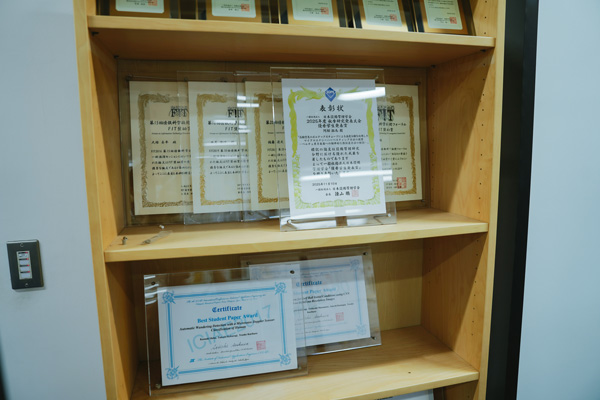
Professor Yosuke Kurihara's systematic research on "measurement and evaluation of human biological, behavioral, and cognitive characteristics based on sensing technology" has been awarded the "2025 Aoyama Academic Award."

What is Aoyama Academic Award?

This award is given to full-time faculty members of Aoyama who have published achievements recognized as contributing to the advancement of academic research in their respective fields. In the 2025 academic award, which Professor Kurihara received, five faculty members from the undergraduate and graduate schools were awarded in recognition of their systematic research and publications.

The evaluation points are

The research was likely evaluated positively because it has established fundamental technologies such as sensing technology and signal processing, applied them broadly to diverse fields, and because the applications of its research results are directly linked to solving problems for people and society, making the social benefits of the research easily understandable.


Illustration: Arrow

Explore the topic with your teacher

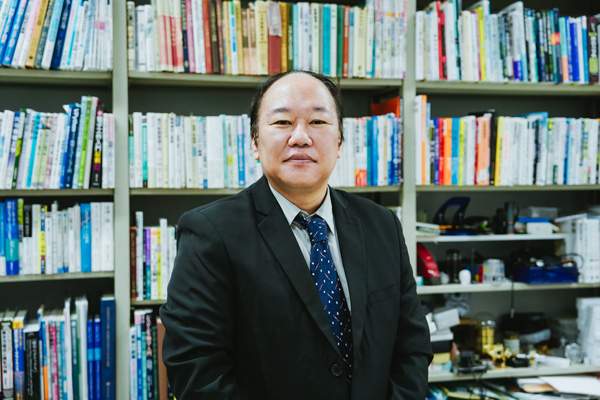
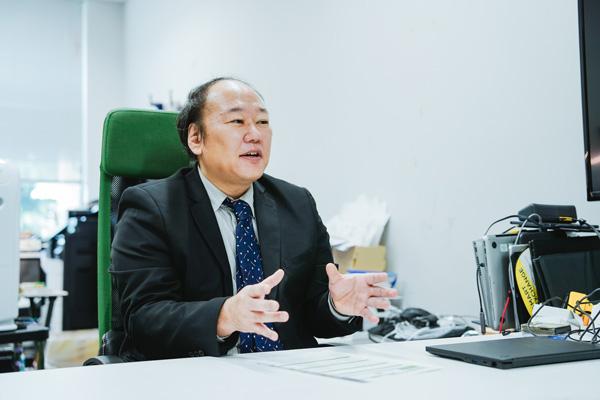
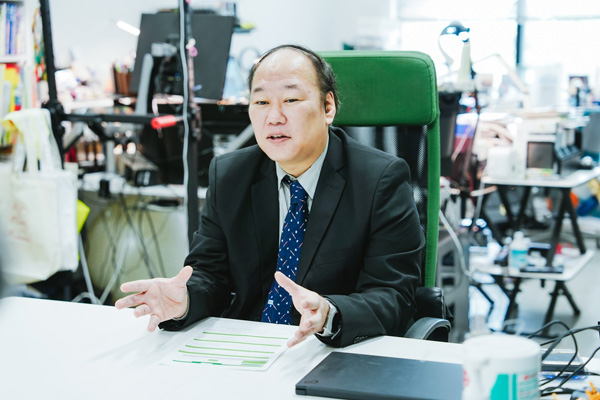
Professor Yosuke Kurihara

He graduated from the Department of Systems and Control Engineering, Faculty of Engineering, Hosei University. After working at the Systems Division of Hitachi Software Engineering Co., Ltd., he entered the Department of Systems Engineering, Graduate School College of Science and Engineering Hosei University. He completed both the master's and doctoral programs at the same graduate school, earning a PhD in College of Science and Engineering. After serving as an assistant professor in the Department of Information Science, Faculty of Science and Engineering, Seikei University, he became an associate professor in the Department of Department of Industraial and Engineering, Faculty of Science and Engineering, Aoyama Gakuin University in 2013. He has been a professor there since 2019. His specialties are systems engineering and sensing engineering. His publications include "Human Robotics: Neuromechanics and Motor Control" (supervision and translation), "Visualization and Mechanism Elucidation of the Five Senses and Cognitive Functions Using Artificial Intelligence" (co-author), and "Technology Applications for the Elderly" (co-author).

What kind of research have you been working on so far?

My areas of expertise are sensing engineering, measurement engineering, and signal processing. Based on these, I am engaged in research that measures various phenomena and information related to humans, equipment, and the environment, and evaluates their state and characteristics. In particular, when measuring human biological information, I place great importance on sensor technology that "measures without restraint." Especially when targeting the elderly, many people are reluctant to wear devices such as smartwatches on their bodies. Taking these challenges into account, I am developing highly sensitive sensors that can measure biological information without being worn on the body.

Another important aspect is creating technology that can be easily and continuously used in real life. No matter how high-performing a technology is, if the cost is high, it will be difficult to spread it widely. From this perspective, we are strongly focused not only on performance but also on being able to implement it at a low cost.

A distinctive feature of this approach is its use of readily available, general-purpose microphones that can be purchased for around 10 or 50 yen each in places like Akihabara. By uniquely modifying these microphones and increasing their sensitivity in a frequency range far lower than that of the human voice, they are able to capture even the slightest vibrations generated by the human body. By utilizing inexpensive and mass-produced components, it becomes possible to design a system with practical application in mind. By simply placing these sensors under a bed, information such as pulse and respiration during sleep can be measured without any physical contact with the body. Furthermore, by analyzing the acquired data, it is possible to understand various information such as health status and lifestyle rhythms. In this way, we are developing research that contributes to solving problems for people and society through sensing technology.

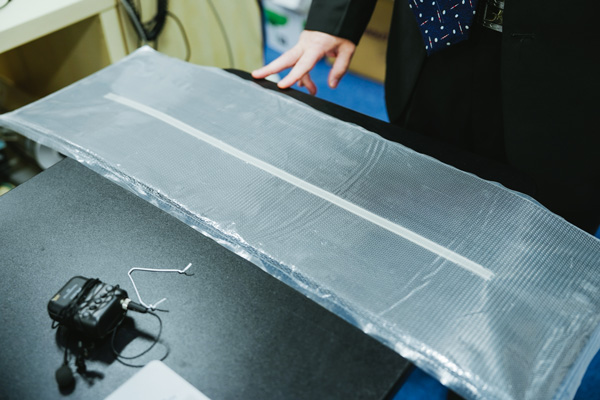
A sheet-type sensor that measures biological information during sleep without restraint.

Are you saying that humans constantly emit low-frequency sounds that are normally inaudible, and that these sounds change depending on the state of the body?

That's right. A good example is the pulse wave. The heart beats with a period of about once per second, and the fundamental frequency of the vibrations generated at that time is in a much lower frequency range than the frequencies that are generally recognized as "sound." For this reason, the sensor is tuned to capture these low-frequency vibrations with high precision. Respiration has an even slower period, appearing as vibrations about once every 5 seconds, but even these minute changes can be measured stably.

On the other hand, indicators such as blood pressure traditionally require the use of compression bandages, making direct measurement without restraint difficult. Therefore, methods are used to indirectly estimate these values based on heart rate information and other data acquired by sensors.

The reason we chose to use microphones is that they are widely available as consumer products and are very inexpensive. Developing sensors from scratch tends to be costly, but by appropriately customizing existing general-purpose products, we can realize a low-cost and highly versatile system. These characteristics are a major advantage in sustainably utilizing the technology in real-world applications. This is one of the key features of this research.
Furthermore, we are exploring how high-precision measurement is possible using inexpensive and readily available technologies, while also utilizing advanced devices such as IoT (Internet of Things) and MEMS (Micro-Electro-Mechanical Systems). We find great significance and interest in these kinds of innovations as research.

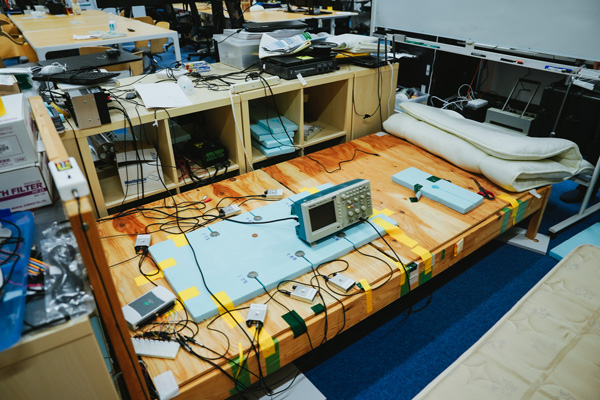
The scene of the verification experiment of the measurement principle.

Are you also researching software-based analysis beyond just measurement?

Yes. My first project was "estimated sleep stages." Subjectively, even if you feel refreshed upon waking, it's difficult to objectively determine whether you've gotten enough rest. So, I developed a system that estimates sleep quality and state based on heart rate data measured during sleep. At the time, smartphone sleep analysis apps were not yet widespread, but I undertook this research with an eye on the future aging society, anticipating a growing need for fatigue recovery and health management. If the analysis results reveal conditions such as "shallow sleep," it can lead to advice on general lifestyle improvements, such as "getting sunlight in the morning." In thisway, I have consistently researched a series of processes, starting with sensing engineering, progressing from "device development," "high-precision sensing," and "software-based analysis" to "application in the medical and nursing care fields."

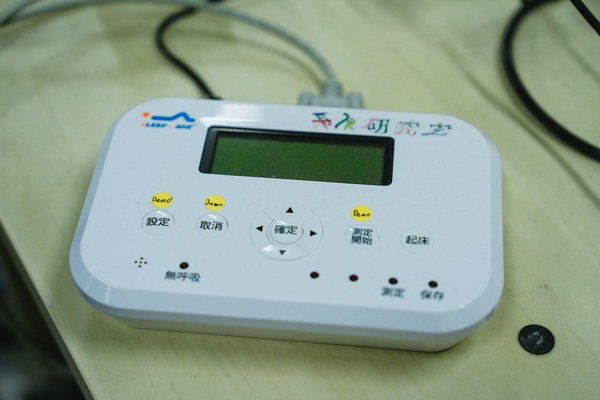
Sensing devices for processing biometric data

Do you also acquire and analyze data other than physical information?

That's right. For example, we're also working on measurements in the architectural field. At first glance, humans and buildings may seem like vastly different subjects. However, although the terminology differs—for example, "health management" when dealing with humans and "quality evaluation" when dealing with buildings such as houses—the basic framework of measuring information, extracting necessary information, evaluating it, and providing it is the same.

Specifically, we are conducting research on improving commercially available differential pressure sensors to easily evaluate the airtightness of houses. In this way, a characteristic of this research is that even if the target is different, we can contribute to solving problems in various fields by applying sensing and analysis technologies.

You conduct sensing in a variety of fields, but where does the richness of your ideas come from?

I believe there are two main types of researchers: the "in-depth" type, who define their area of expertise and pursue it deeply, and the "nomadic" type, who explore the possibilities of application by working across multiple fields. I am definitely the latter type. I often become aware of certain needs and challenges through conversations with people in academic societies and companies, and that's where my research themes are born. I feel that my experience working in research and development at a private company after graduating from university has given me a strong foundation, not only in academic perspectives but also in a way that starts with understanding needs. Furthermore, the realization that "there are things you can only see by actually going to the site" has strongly influenced the direction of my research, as the saying goes, "visit the site a hundred times."

We are sometimes asked if the wide range of applications is challenging, but in reality, we don't find it particularly burdensome. This is because we are not building methodologies from scratch for each field; rather, we are deploying the foundational schemes we have already established to each area. The core concepts and technologies are common, and we then make adjustments according to the specific target.

For example, even when tackling a new application area, verification can be completed in just a few weeks if it's at the stage of confirming the validity of the principle as a basic experiment. Of course, the subsequent processes of improving accuracy and ensuring quality with a view to collaborating with companies will take some time, but the foundational parts can be deployed in a relatively short period of time.

Are there really that many ideas that could serve as the basis for applications?

Through repeated dialogues with people working in various fields such as healthcare, nursing care, and construction, we often find that many challenges and ideas are presented by those working in the field. It's difficult to generate new ideas by consciously trying to "come up with new ideas," but by naturally sharing worries and challenges in everyday conversations, we can gain insights into "how we might be able to solve this."

One concrete example of research that emerged from dialogue is the "measurement of swallowing function." In elderly individuals, a decline in swallowing function increases the risk of aspiration pneumonia, where food or saliva accidentally enters the airway, allowing bacteria to multiply. To reduce this risk, there was a need for a method that could easily and routinely check swallowing function.

Conventional methods use X-ray fluoroscopy, but this examination requires a set of steps and involves the risk of radiation exposure, making it impractical to perform such examinations repeatedly on a daily basis. Therefore, we have developed a system that applies microphone technology previously used for measurements under the bed and can be worn around the neck or ears, like a hearing aid or necklace, to measure larynx movement and vibrations during swallowing, allowing for a daily monitoring of swallowing function.

In this way, listening to the challenges on the ground and considering what kind of technical support is possible to address them leads to the creation of new research themes.

As the system's applications expand, what are the key factors for its successful use?

In reality, even if a system is introduced to a site, it is not always utilized. While it's easy to think that more features mean greater usefulness, the work environment is often extremely busy, and introducing a new system can itself be a burden. A feature highly valued at one facility might be rejected at another because "having two buttons makes it difficult to use." From these experiences, we've come to realize that, in order to achieve widespread adoption, it's essential to design a system that is as simple as possible and intuitive to operate.

Furthermore, how information is presented—that is, the design of the user interface (UI/UX) and user experience—is also extremely important. While quantitative graphs are emphasized in academic settings, in real-world situations, the ability to "understand the status at a glance" is required. For example, expressions that are not intuitively understandable, such as "if the flower is blooming, there is no problem; if it is wilting, caution is needed," are unlikely to be accepted.

From this perspective, when developing systems in collaboration with companies, we emphasize that "not only accuracy, but also ease of use and presentation are important for widespread adoption." Looking beyond simply compiling results into academic papers, and instead focusing on actual use and ensuring users perceive value, is a key motivator for our research.

Finally, could you tell us about any fields you would like to challenge yourself in the future, or anything you value in your research and education?

Looking ahead, our challenges include expanding our application fields and deepening our theoretical foundations. Ultimately, our goal is to provide a pathway that enables anyone to build applied systems. To fundamentally understand the data obtained through sensing and the behavior of systems, the existence of mathematical models that appropriately describe them is essential. From this perspective, we are also working on research that deals with topics such as errors in numerical integration methods in differential equations and geometric distortions of characteristic roots that represent the behavior of systems, analyzing how numerical calculations affect the inherent properties of systems. We emphasize not just showing "measured results," but also theoretically understanding the phenomena and structures behind them.

Furthermore, as a university researcher and faculty member, I place as much importance on drawing out students' ideas and translating them into concrete forms as I do on research itself. For example, in research on recovering energy generated when compressed air is discharged from a factory, a student proposed the idea that it might be possible to generate electricity by combining a "vortex tube" (a device that separates compressed air into high-temperature and low-temperature flows) and a "Peltier element" (a device that generates electricity based on temperature differences). This idea stemmed from the student 's ongoing interest in various devices and has been recognized as excellent research at academic conferences. In this way, I aim to explore both theory and application, while also fostering the flexible thinking of students to create new value.

*The affiliations, Position, and research topics of the individuals listed are as follows:
This information is generally based on the time of the interview.

Related Content

  • Faculty of Science and Technology, Department of Electrical and Electronic Engineering
  • Published on 2026/06/05
  • We have established an evaluation method using the electroluminescent (EL) method that does not cause performance degradation of perovskite solar cells.
  • Assistant Professor Itaru Kifuku
  • Perovskite solar cells are expected to become widely adopted in the future because they possess functions that compensate for the weaknesses of conventional silicon-based solar cells. Assistant Professor Itaru Raifuku has established a method that can apply the EL method, one of the evaluation methods used for conventional silicon-based solar cells, to perovskite solar cells, attracting considerable attention at an international conference.

  • 理工学研究科 理工学専攻 電気電子工学コース 博士後期課程3年(受賞時)
  • 掲載日 2025/07/30
  • 1つの形で表されない非線形システムを追究し、未来の自動化システムへの貢献を目指す
  • 浅井 佑仁 さん
  • 入力と出力の値が単純に比例しない「非線形システム」。世の中の99%を占めると言われるこのシステムをこれまで以上に的確に制御し、さらなる自動化への道筋に対して数学的にアプローチしている浅井さん。博士後期課程1年次には学会での表彰も受け、博士修了後の現在も研究のさらなる深化に励んでいます。

  • Faculty of Science and Technology, Department of Electrical and Electronic Engineering
  • Posted on 10/12/2024
  • Development of easily recyclable solar cell module for a new era of solar power generation
  • Professor Yasuaki Ishikawa
  • It is expected that in the near future, a large amount of currently used solar power generation modules will be discarded, resulting in an increase in industrial waste. In order to utilize solar power generation nationwide as a major power generation method in the future, technology to realize environmentally friendly modules is required. Professor Ishikawa is conducting research with other researchers to establish recycling technology for solar cell modules.

For inquiries regarding "research and industry-government-academia collaboration," please click here

Return to the list of "Topics Creating the Future"