AGU RESEARCH

Topics that shape the future
- Closer look at research results -

Aoyama Gakuin University faculty members:
He is an uncompromising researcher.
Aiming for a prosperous society,
We are always conducting cutting-edge research.
We will explore the research results of our faculty members who are shaping the future.

  • Faculty of Science and Technology, Department of Electrical and Electronic Engineering
  • Published on 2026/06/05
  • We have established an evaluation method using the electroluminescent (EL) method that does not cause performance degradation of perovskite solar cells.
  • Assistant Professor Itaru Kifuku
  • Faculty of Science and Technology, Department of Electrical and Electronic Engineering
  • Published on 2026/06/05
  • We have established an evaluation method using the electroluminescent (EL) method that does not cause performance degradation of perovskite solar cells.
  • Assistant Professor Itaru Kifuku

TOPIC

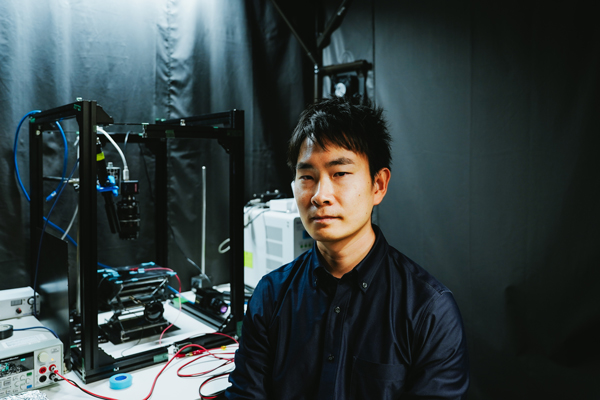
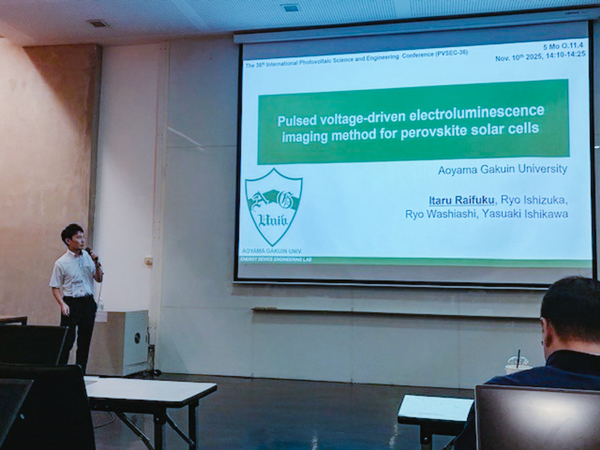
Assistant Professor Itaru Raifuku received the "Best Oral Presentation Award" at the international conference on solar cells, "PVSEC36".

What is the International Society for Photovoltaics and Cellular Growth (PVSEC)?

Held annually, primarily in Asia, this international conference on solar cells is sometimes referred to as one of the "world's three major solar cell conferences." Researchers from all over the world gather to present and discuss the latest research findings on solar cell materials, device structures, evaluation technologies, and more. Among the approximately 200 oral presentations, Assistant Professor Raifuku's presentation was selected for the "Best Oral Presentation Award," an award given to only 14 recipients.

What are perovskite solar cells?

Compared to existing silicon solar cells, these solar cells are thinner, lighter, easier to design in terms of shape, and have the ability to adjust the wavelength of light they absorb. Therefore, they are expected to have diverse applications, including installation in buildings, vehicles, and even indoors. However, they also have challenges, such as a tendency for performance to degrade over time. Currently, research is underway worldwide to improve durability and quality in order to achieve practical applications.

Evaluation points

Various evaluation methods are being researched and considered to measure the performance of perovskite solar cells. While each method has its advantages and disadvantages, Assistant Professor Raifuku focused on a method that identifies which layer inside the solar cell is performing poorly by passing electricity through it and observing the light emission. He then discovered and established a method to apply the electroluminescence (EL) method, which is already used in silicon solar cells, to perovskite solar cells, and this was highly praised at an international conference.


Illustration: Arrow

Explore the topic with your teacher

Assistant Professor Kifuku

He completed his studies in the Department of Materials Engineering at Yonago National College of Technology. He also completed his master's and doctoral programs in Materials Science at the Graduate School of Materials Science, Nara Institute of Science and Technology, earning a PhD in Engineering. After serving as a postdoctoral researcher at National Cheng Kung University and an assistant professor at the Graduate School of Science and Technology, Nara Institute of Science and Technology (concurrently serving as an assistant professor at the Data-Driven Science Creation Center), he joined the Department of Department of Electrical Engineering and Electronics, Faculty of College of Science and Engineering Engineering, Aoyama Gakuin University as an assistant professor in April 2023. His area of expertise is semiconductor engineering. His main research themes include the development of indoor solar cells, including perovskite solar cells, and the improvement of efficiency and evaluation technologies for next-generation solar cells.

What are perovskite solar cells?

Currently, the solar cells that are widely used around us are mainly silicon-based solar cells. These have significant advantages, such as relatively low production costs, high efficiency in converting sunlight into electricity, and stable performance over long periods of time. However, silicon-based solar cells also have drawbacks, such as being very flat, easily broken, and unable to be bent.

"Perovskite" is a general term for crystals that have a lattice structure in which atoms are arranged in a cubic pattern. Perovskite solar cells utilize this crystal structure and, unlike silicon-based solar cells, are thin, light, and flexible. Therefore, one of the major advantages of perovskite solar cells is that they aim for high conversion efficiency and low cost comparable to silicon-based solar cells, while compensating for the limitations on shape flexibility of silicon-based solar cells. For example, applications such as attaching them to the body or interior of automobiles to generate electricity are being considered.

In addition to being lightweight and flexible, perovskite solar cells also have the advantage of easily controlling the wavelength of light they absorb. Wavelength is the distance from peak to peak when light travels as a wave, and the properties of light differ depending on this length. While silicon-based solar cells are mainly designed for outdoor sunlight, perovskite solar cells allow for precise control of wavelength, making it possible to design them for indoor light as well. As a result, a major feature of perovskite solar cells is that they can be attached to various objects and used to efficiently generate electricity using indoor light.

What are your main areas of focus in your research on perovskite solar cells?

We conduct various research projects, but for example, in perovskite solar cells, the perovskite layer that captures light is sandwiched between an electron transport layer that carries electrons (negative charge) and a hole transport layer that carries holes (positive charge). We are researching materials that will further improve the properties of this perovskite layer itself. We are also working on research to improve the performance of the transport layer that supports this and allows for more efficient extraction of electricity.

For example, there are a great many types of material candidates for the transport layer, and it would take an enormous amount of time to actually fabricate each one as a solar cell and then conduct experiments and evaluations. Therefore, we use simulations to consider how to proceed more efficiently on a daily basis, and then conduct actual experiments based on the results.
Furthermore, we are also developing evaluation technologies for perovskite solar cells, such as the one that earned us an award at the international conference.

What are the challenges to the practical application of perovskite solar cells?

While perovskite solar cells offer various advantages, they also have the drawback of being prone to degradation. Establishing a simple method for evaluating this degradation is crucial for the stable operation of solar cells in the future. For example, it is essential to have an easy-to-use evaluation method not only to assess whether installed solar cells continue to generate power as expected, but also to determine whether the solar cells are being manufactured correctly during the manufacturing process.

What are the evaluation methods for perovskite solar cells?

Several methods have already been devised to evaluate the performance of perovskite solar cells. Currently, the most commonly used method involves irradiating the cells with simulated sunlight and measuring the current and voltage characteristics to evaluate conversion efficiency and the power that can be generated. This method has the advantage of being able to evaluate the performance of the entire solar cell with very high accuracy. On the other hand, it has the challenge of not being able to determine which part of the solar cell is degrading if degradation has occurred.

In contrast, the method I am researching is called the EL method, which involves passing electricity through the materials of perovskite solar cells. This method has the advantage of being able to identify which layer's performance is degraded in a solar cell, which is made up of various stacked materials.

Thus, it's not possible to easily judge everything using just one evaluation method. We believe that it will continue to be important to evaluate battery performance by combining the strengths of each method.

What exactly is the EL method that you are researching, Professor?

EL method, short for "Electroluminescence method," is an evaluation technique that uses electricity. It is a widely used inspection technique for evaluating the performance of silicon-based solar cells, which are commonly used today. By passing electricity through the battery, it emits light, and the performance is evaluated by observing the state of emission. Because this method can be performed simply by passing electricity through it, there is no need to disassemble or take apart the battery, and it has the advantage of being able to be performed immediately on-site in the factory manufacturing process or at the product installation site. It also has the advantage of making it easy to visually identify defective areas by observing the presence or absence of light emission.

However, applying this electroluminescent (EL) method to perovskite solar cells has presented a major problem until now. This is because perovskites have the characteristic of degrading performance when electricity is passed through them. Therefore, when evaluating with the EL method, the measurement itself degrades the performance of the solar cell. In response, our laboratory analyzed the mechanism of degradation using various methods and, based on the results, optimized the conditions to successfully establish an EL method that does not cause degradation.

What kind of method was used to prevent deterioration?

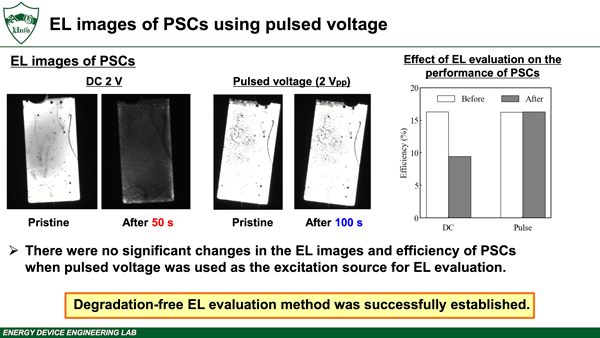
Perovskite materials are ionic crystals, which are materials composed of ions. Therefore, when a voltage is applied, negatively charged ions move significantly towards the positive side, and positively charged ions move significantly towards the negative side. Through continued research, it gradually became clear that this ion movement was the cause of degradation. It is known that ion movement is particularly likely to occur when a direct current is applied. One day, a student who was conducting an experiment with alternating current said to me, "The solar cell keeps glowing!" The light emitted by the perovskite solar cell, which would normally emit a weak light and then disappear after a few tens of seconds, was glowing brighter than anything I had ever seen before.This incident made a strong impression on me and led to the realization, "Ah, I should use alternating current!" This simple idea became a breakthrough and led to the establishment of the EL method, which does not degrade solar cells.

The image on the left shows a perovskite solar cell with a direct current applied for 50 seconds, while the image on the right shows a perovskite solar cell with an alternating current applied for 100 seconds.

At first glance, it seems like a simple idea, but has the concept of using alternating current not been tried much before?

That's right. Many researchers focus on the study of solar cells themselves, and the field of inspection technology hasn't received much attention. As a result, once it was recognized that "applying the EL method is difficult," there may not have been an opportunity to reconsider that approach. In my case, I specialized in chemistry until I went to graduate school, and while I conducted research on solar cells in graduate school, I was also affiliated with a semiconductor engineering laboratory. So, I have studied a fairly broad range of subjects, and perhaps that experience has led to a broader range of ideas and interests.

Receiving the "Best Oral Presentation Award" at this prestigious conference, considered one of the world's three largest solar cell conferences, demonstrates the growing interest in the application of the electroluminescence (EL) method to perovskite solar cells. Furthermore, this achievement serves as a great encouragement for our future development of even more useful evaluation methods.

What kind of research do you plan to pursue going forward?

First, in the field of EL (electroluminescence) methods, this research was conducted in an indoor environment, but in the future, we aim to develop a method that can evaluate solar cells in their actual installed state (outdoor environment). If this is achieved, it will lead to the establishment of a system that eliminates the hassle of removing and transporting solar cells, which is one of the advantages of EL methods, and allows for on-site evaluation. On the other hand, when applying this method in an outdoor environment, there is a challenge in that the weak light emission from perovskite solar cells is buried in sunlight. In the future, we would like to work on overcoming this challenge and aim to realize a technology that enables highly accurate evaluation even outdoors.

Furthermore, from a broader perspective, since perovskite solar cells use lead-containing materials, environmental impact is also a crucial issue. Therefore, we would like to work on realizing technologies that meet societal needs, such as developing lead-free solar cells. Perovskite solar cells are still a developing field, and while there are many challenges to overcome, it is also a field where new research themes are constantly emerging. From this standpoint, I feel that there will be no end to the themes we should continue to challenge ourselves with in the future.

Please give a message to prospective students and university students who are about to embark on research.

First of all, I believe that during your first and second years of university, learning a wide range of subjects regardless of your interests will broaden your future career path. I myself feel that the accumulation of broad learning led to the results of my current research. Therefore, I think that studying not out of inertia, but proactively engaging in various learning activities out of genuine interest, is what leads to the enjoyment and fulfillment of research.

Furthermore, while utilizing AI will become commonplace in the coming era, human expertise will be more important than ever to effectively use AI as a tool without being overwhelmed by its responses. The College of Science and Engineering at Aoyama Gakuin University has an exceptionally rich research environment. We encourage you to utilize various devices here, apply your ingenuity, and grow into an "AI native" individual who can create new value in collaboration with AI.

*The affiliations, Position, and research topics of the individuals listed are as follows:
This information is generally based on the time of the interview.

Related Content

  • Faculty of Science and Engineering, Department of Physical Sciences
  • Posted on 2023/06/16
  • Discovering the mathematical formula that describes the movement of chromosomes within cells
    ~Unraveling the mysteries of life from a physical perspective~
  • Professor Takahiro Sakaue
  • A collaborative research project involving Professor Takahiro Sakaue, who discovered that the movement of chromosomes within living cells can be expressed in a physically simple mathematical formula based on Brownian motion, has been published in the prestigious scientific journal "Physical Review Letters." The biological field of intracellular movement is viewed from a physical perspective based on the concept of Brownian motion, and the movement of chromosomes (chromatin) moving within cells is expressed in a simple mathematical formula. It is expected that this will lead to elucidation of the mechanisms of heredity in the future.

  • College of Science and Engineering, Department of Chemistry and Biological Science
  • Posted on 2024/07/02
  • Investigating the luminescence properties of helical complexes that take advantage of the properties of rare earth elements
  • Professor Miki Hasegawa
  • A complex is a compound in which a metal ion is surrounded by organic molecules or other ions. Professor Miki Hasegawa of the Faculty of Science and Technology, who has long been developing molecules that emit light by using rare earths in the metal part and elucidating their functions, has been awarded the Rare Earth Society of Japan's most prestigious award, the Shiokawa Award. His original approach to creating a helical structure in which molecules are wrapped around rare earth ions has also attracted a great deal of attention, as has his creation of molecular models with various luminescent functions.

  • College of Science and Engineering, Department of Integrated information technology
  • Posted on 2025/03/25
  • Explaining the movement of objects and artists' brushstrokes through physical calculations
  • Professor Yonghao Yue
  • When watching movies, today's CG seems to depict various real-world objects as they are. However, it is still difficult to accurately reproduce the light (color) and movement of objects through calculations, and many parts of it are done by hand by artists. Professor Raku is conducting research to realize even more accurate CG through a mathematical approach.

For inquiries regarding "research and industry-government-academia collaboration," please click here

Return to the list of "Topics Creating the Future"