In the world we live in,
From issues close to us to issues that affect all of humanity,
There are many different problems.
The current situation and truth that are surprisingly unknown,
Our proud faculty members offer interesting insights
We will reveal it.
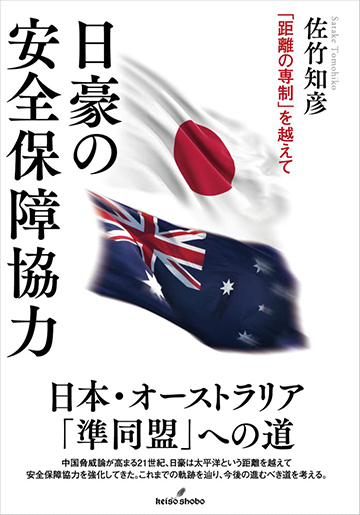
My research focuses on international relations and diplomatic issues in the Asia-Pacific and Indo-Pacific regions, particularly alliances and security cooperation. Since joining the National Institute for Defense Studies of the Ministry of Defense in 2010, my main research theme has been security cooperation between Japan and Australia. I reached a milestone in 2022 with the publication of my first book on this topic. In the future, I plan to broaden my research to include security cooperation and defense policy with South Korea and India.

In the post-war Asia-Pacific region, bilateral alliances centered around the United States, known as "hub-and-spokes," have been maintained. Unlike Europe, where collective defense systems like NATO have developed, the Asia-Pacific region, where nations are separated by the sea and where countries vary greatly in size, economic development, political systems, and values, has maintained "vertical ties" with the United States, but "horizontal ties" among allies have not developed significantly.
However, with the end of the Cold War, cooperation among allies, not just with the United States, gradually developed. A prime example of this is security cooperation between Japan and Australia. It may be hard to imagine now, but Australia was a fierce adversary of Japan during World War II. However, after the war, relations deepened, mainly economically, and after the Cold War, they further narrowed their distance in security. Today, both Japan and Australia are close allies of the United States and share a common emphasis on liberal democratic values. Some even refer to Australia as a "quasi-ally" second only to the United States.
On the other hand, relations between Japan and South Korea have not always been smooth, partly due to historical issues. However, in recent years, with the rise of North Korea and China, security cooperation between Japan and South Korea has been gradually progressing. I am interested in how this strengthening of "horizontal ties" among allies and regional countries will affect the future regional security environment.
My area of expertise, international relations, has historically developed primarily around Western countries such as the United States and the United Kingdom. Research on Japanese security has also mainly focused on the Japan-U.S. alliance, but now the center of gravity of international political economy has shifted from the West to Asia. Furthermore, the rise of the Trump administration has made U.S. regional involvement even more unstable. In this context, the question of whether regional countries, including Japan, can maintain regional stability while strengthening horizontal cooperation is the primary concern of my research.

My interest in studying Japan-Australia and Japan-South Korea relations began during my language study abroad in Australia after graduating from high school. At the time, I had the opportunity to discuss international issues and each other's countries with international students from various countries, but I was acutely aware of my own lack of knowledge and felt frustrated. This bitter experience became the starting point for my pursuit of a career in international relations.
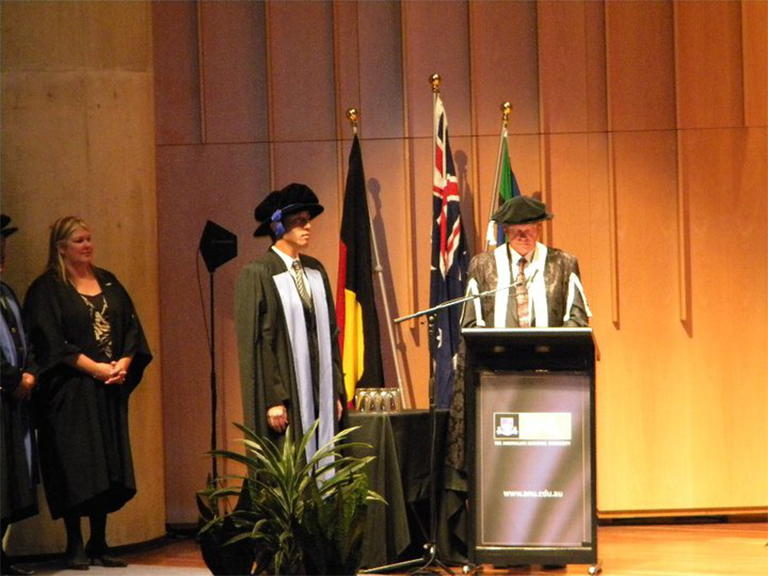
At university, I studied Japanese defense and foreign policy, and after completing my master's degree, I returned to Australia. At the Australian National University Graduate School, I noticed many similarities and commonalities in post-war Japanese and Australian security policies, and my doctoral dissertation focused on a comparative study of the Japan-U.S. alliance and the U.S.-Australia alliance. Since then, I have continued to research international relations in the Asia-Pacific region, with Japan and Australia as my focus.

Photo from the degree conferment ceremony at the Australian National University Graduate School.
I originally chose a career in research because I've always enjoyed thinking deeply about specific topics. I think my father, who was also a researcher, had a significant influence on me. The process of formulating hypotheses and then proving them through careful thought is the essence of research. The surprise and sense of accomplishment I feel when I re-examine things without being bound by existing frameworks and arrive at a new discovery is what motivates me to continue my research.
In 2023, I moved my research base from the National Institute for Defense Studies to this university. There were several reasons for this decision, but the biggest motivation was my desire to conduct research from a freer, more objective, and comprehensive perspective. Also, during my time at the institute, I had many opportunities to participate in training at Self-Defense Forces bases, interact with high-ranking officials from various governments, and directly discuss matters with Ministry of Defense officials and Self-Defense Forces personnel. I wanted to share the knowledge I gained about the "real-world" aspects of security through these experiences with a wider audience. Since moving to the university, I have also come to find great appeal in the time I spend deepening discussions while exchanging opinions with students. Currently, I strive to conduct interactive classes, such as lectures that incorporate case studies and policy simulations with students, utilizing my previous practical experience. Since there are still few classes that specialize in teaching security, I feel that the students listen to the lectures with sparkling eyes and deepen their understanding. Inspired by this, I am consciously incorporating elements of active learning and putting effort into education.
One of the most memorable words from my university professor was, "Investigate your research topic with the intention of knowing more about it than anyone else in the world." When we think of research, we tend to focus only on results and outcomes, but much of the actual work involves very painstaking tasks such as finding previously undiscovered materials or reading through vast amounts of documents from think tanks. Also, since I deal with many contemporary policy issues, I have many opportunities to interview people with practical experience. Even important figures such as former ministers and former vice ministers of foreign affairs are often willing to speak to me, providing me with invaluable opportunities to hear directly from those on the ground.
In conducting my research, I value having both a broad, bird's-eye view and a close, on-the-ground, insect's-eye view. Becoming too engrossed in abstract discussions and concepts prevents me from explaining the complexities of our real world, while conversely, focusing too much on minute details can cause me to miss the larger picture underlying those details. My motto is "truth lies in the details," and I strive to carefully investigate events while maintaining a broad perspective. Furthermore, it's crucial to consider things from different viewpoints, without being confined to the perspective of a single country, and to comprehensively grasp diverse factors to understand them from multiple perspectives. In the world of research, it's often said that "counter-intuitive" research—that is, research that goes against common sense and overturns conventional wisdom—is particularly valuable. And this resonates with university learning as well.
I strongly encourage all of you studying international relations to experience studying abroad. While I myself struggled with language barriers and differences in living environments during my time abroad, it also allowed me to learn about diverse values and significantly changed my perspective on life. In particular, Japan is still somewhat isolated in the field of security. To gain a comprehensive understanding of international relations and correctly grasp Japan's position and strategy, an international perspective is essential. To gain a deeper understanding of the Asian region, you should consider studying in countries such as Australia, South Korea, India, and Indonesia.
University is not a place where you passively acquire knowledge, but a place where you proactively engage in learning. You gain nothing if you don't take action. Don't be bound by popular understanding or "common sense," but deepen your learning with a voracious appetite, driven by intellectual curiosity and with free thinking. Furthermore, in today's information-saturated society, it is also important to cultivate critical thinking and the ability to discern accurate information. While there are opportunities to use AI and ChatGPT in classes, what is important is how you interpret and apply information. This kind of awareness leads to the "ability to think for yourself." I would like to continue to strive to be a presence that supports the growth of students who continue to challenge themselves with high aspirations.

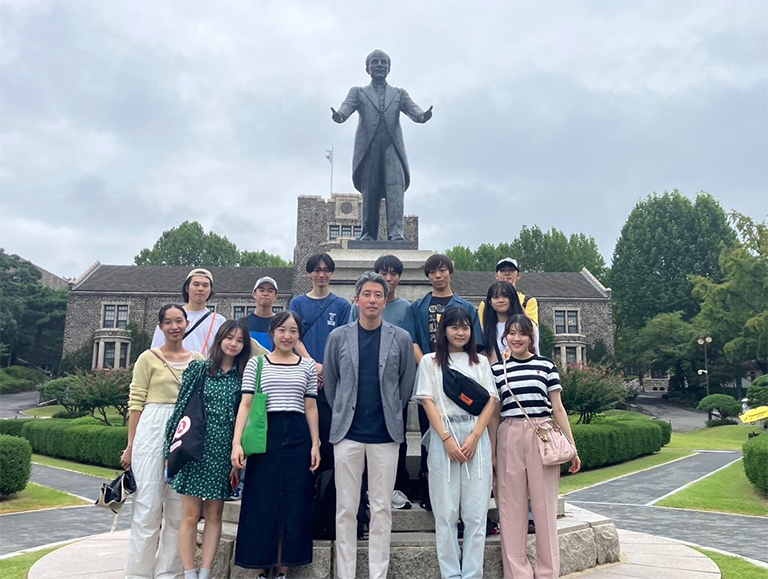
A group photo taken at Yonsei University in South Korea during a seminar retreat.