AGU RESEARCH

Columns that reveal the world
- Getting up close and personal with the researchers -

In the world we live in,
From issues close to us to issues that affect all of humanity,
There are many different problems.
The current situation and truth that are surprisingly unknown,
Our proud faculty members offer interesting insights
We will reveal it.

  • School of International Politics, Economics and Communication, Department of International Politics
  • Published on 2025/05/16
  • Unraveling the causal relationships of conflicts and wars, and deriving logic that can be applied to similar cases.
  • Professor Yasuhiro Izumikawa
  • School of International Politics, Economics and Communication, Department of International Politics
  • Published on 2025/05/16
  • Unraveling the causal relationships of conflicts and wars, and deriving logic that can be applied to similar cases.
  • Professor Yasuhiro Izumikawa

International relations theory identifies and explains similar patterns in the history of international politics.

Why do people repeatedly engage in conflicts and wars? In international relations theory, one of my research areas, I analyze the causes from the perspective of international politics and relations between states. Within international politics, there are quite a few cases of wars and arms races that occurred in different places and times but show very similar patterns. Finding the common logic inherent in these cases and exploring whether it can be confirmed in other cases is an important part of my research. As a method for finding and confirming patterns, there is an approach that uses statistical analysis with a database of past international conflicts, but I deal with orthodox case studies. I am particularly interested in alliance politics in East Asia. Since the start of the Cold War between the United States and the former Soviet Union, multilateral collective security systems such as NATO (North Atlantic Treaty Organization) have been born in Western countries and have expanded further after the end of the Cold War. In contrast, a "hub-and-spoke type alliance system" has taken root in East Asia. This system refers to an alliance system composed of bilateral alliances centered on the United States, extending from the center (hub) of a wheel to spokes (local bases). The spokes of this alliance connect countries such as Japan, South Korea, the Philippines, and Australia. These are all alliance systems established in the mid-20th century, but despite facing the same threat from communist states at the time, why did they take different forms? I have focused my research on this point.

Currently, we are conducting collaborative research on the "institutionalization of alliances." This research aims to find the logic behind how allied countries promote military cooperation and how they establish mechanisms for policy coordination, including command and control systems, in peacetime and wartime. In addition, I have long worked on "alliance division strategies" to break up hostile alliances, and conversely, "alliance binding strategies" to maintain and strengthen one's own alliances. In the future, I would like to advance research that clarifies the characteristics of the international system, centered on the US and China, and also attempt to position my own research within the current trends in theoretical research.

We collect and analyze case studies from various countries, including Japan, Taiwan, the Korean Peninsula, China, and the former Soviet Union, and examine their significance within the framework of international politics. Furthermore, we are currently working on compiling these research findings into a specialized book in English and publishing it.

In line with changes in international relations, the focus of research is shifting from Europe and North America to East Asia.

In November 1989, the fall of the Berlin Wall in Germany symbolized the political reforms that progressed in Eastern European countries and the former Soviet Union, bringing an end to the long-lasting Cold War between East and West. At the time, I was a fourth-year university student, and I remember a German exchange student I knew being extremely happy about the fall of the wall. Feeling a sense of exhilaration at witnessing such a major turning point in history, and wanting to see the events with my own eyes, I traveled to Europe alone for my graduation trip, visiting Hungary and the former Czechoslovakia, which were in the midst of democratization movements, and was greatly inspired.

At the time, I never imagined becoming a researcher, so after graduation I took a job at a private company. Although I found the work fulfilling, my interest in international relations never faded, and four years later I decided to quit and study at a graduate school in the United States. After completing my master's degree, I moved to the political science department of another university and continued on to the doctoral program. It was around this time that the focus of my research gradually shifted from Europe and the United States to East Asia. The late 1990s was a period that showed signs of significant transformation in international relations in East Asia, with changes beginning to be seen in Japan's foreign and security policies, and the North Korean nuclear development problem becoming more serious.

I have been researching the division of alliances since I began my doctoral dissertation research in graduate school. At the time, there were very few people doing similar research, but in recent years, it has attracted more attention as China has risen and the situation in East Asia has changed. In recent years, I have expanded my activities, such as being invited to give lectures at American think tanks and participating as an advisor to a research group at a Belgian university.

In particular, themes such as "alliance division strategies" and "alliance binding strategies" are attracting increasing attention from researchers because they directly relate to the current situation where China is trying to drive a wedge into the relationship between Japan and the United States, or between the United States and Europe. I feel that my research is playing a part in understanding real-world society.
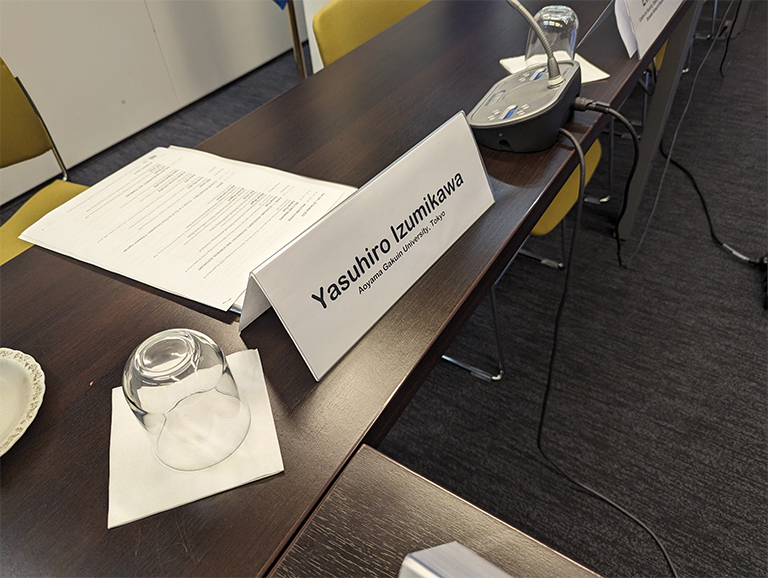
At the "US-China Competition and Europe" symposium held in October 2023 (Brussels)

However, the reality is that there are still very few Japanese researchers who are active internationally in these fields. I don't think that I should do anything special just because I'm Japanese, but as a researcher specializing in international relations, I have a strong belief that my activities should not be confined to Japan alone. Because the "domestic market" for theoretical research in international relations, which is my specialty, is still small, the impact is inevitably limited if I publish only in Japanese. For this reason, I basically write my papers in English and strive to actively disseminate them overseas.

To date, I have had papers published twice in the American academic journal *International Security*, a top journal in the field of international security, in 2010 and 2020. Both papers took more than five years from initial writing to publication, and were completed after much trial and error, so I felt a great sense of accomplishment when they were accepted for publication. In the latter case, the editor of the journal secretly submitted it for an academic award, and thanks to that, I won the 2021 Best Published Paper Award from the "History and International Politics Section" of the American Political Science Association, a world-renowned authority in the field of political science. I never thought I would ever win an award, so I can't thank them enough.
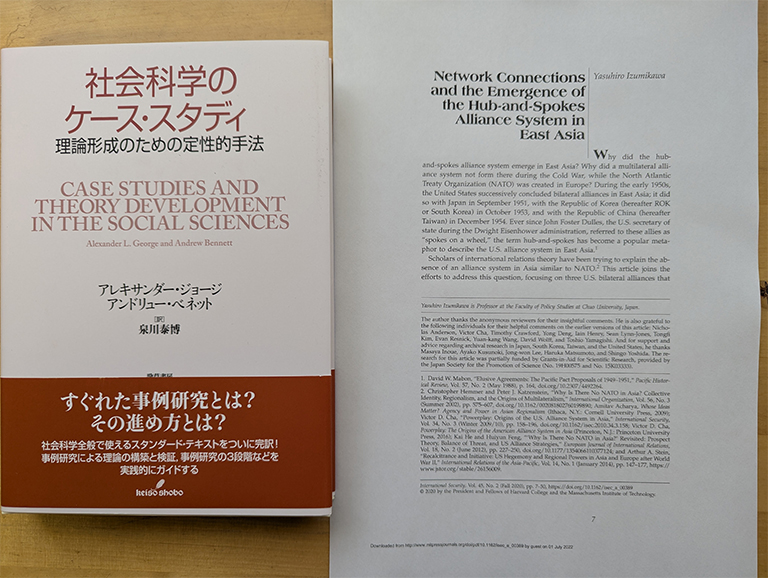
A translation of a renowned book on qualitative methods and a paper that won a US academic award in 2021.

The "deep thinking ability" cultivated through the process of thoroughly investigating cause and effect.

Political topics that are covered in the media every day are often forgotten over time, without the validity of the perspectives and analyses at the time being reviewed. However, research is the act of not letting such events get buried in the flow of history, but rather of thoroughly considering the causal relationships behind them. The essence of my research lies in discovering theoretical logic. For example, if I find a pattern where "a certain factor causes a specific phenomenon," and the same pattern is confirmed in completely different environments, it suggests that there may be some kind of generality or unified theory at play. This process of deeply considering and understanding things is the real thrill of research. If we take a step further and explore causal relationships, we may be able to logically explain similar situations when they occur again and take some kind of countermeasures. This attitude is applicable not only to research but also to the business world and various other situations.

Some high school students may feel anxious about exams or wonder, "Will the knowledge I've learned really be useful in the future?" However, seriously engaging with university entrance exams and studying is a very important process for developing fundamental "thinking skills." English, in particular, is a crucial skill, so please make sure to master it. There are criticisms that English education in Japan "lacks practicality," but that is simply not true.

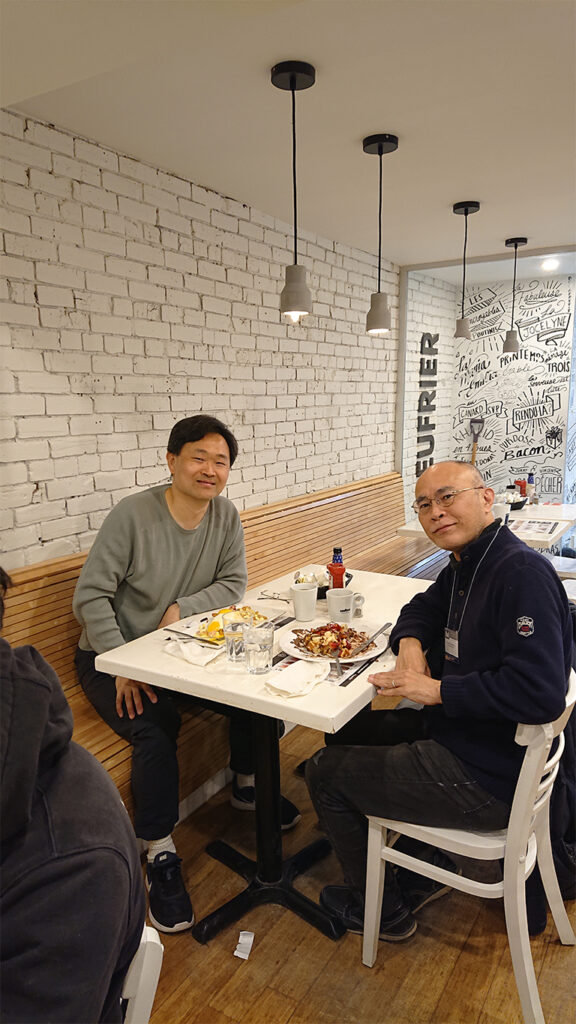
Breakfast meeting with Professor Yuan-kang Wang, a friend from graduate school (Montreal, March 2023)

However, Japanese education has a challenge in that it offers few opportunities to cultivate the ability to think logically and to test ideas derived from observation. Research is a process that involves identifying a problem, formulating a hypothesis, gathering evidence, and verifying it to arrive at a conclusion. While high schools in Europe and the United States offer many opportunities to learn these basic research methods, such education is not yet widespread in Japan. That is why universities place great importance on cultivating the ability to think deeply. We believe that this ability will be a universal skill that will be invaluable in navigating society, no matter what path one chooses to take in the future.

Related articles

  • Yasuhiro Izumikawa, "To Coerce or Reward? Theorizing Wedge Strategies in Alliance Politics," Security Studies, Vol. 22, No. 3 (2013).
  • Yasuhiro Izumikawa, "Binding Strategies in Alliance Politics: The Soviet-Japanese-US Diplomatic Tug of War in the Mid-1950s," International Studies Quarterly, Vol. 62, No. 1 (2018).
  • Yasuhiro Izumikawa, "Network Connections and the Emergence of the Hub-and-Spokes Alliance System in East Asia, International Security, Vol. 45, No. 2 (2020).
  • Network Connections and the Emergence of the Hub-and-Spokes Alliance System in East Asia | The Belfer Center for Science and International Affairs
  • Yasuhiro Izumikawa, "Dynamic Alliance Theory: Interaction between Divide-and-Consolidate Strategies and US-China-Soviet Relations in the Early Cold War," *International Politics*, No. 206 (2022).
  • A. George and A. Bennett, *Qualitative Methods for Case Study Theory Formation in Social Sciences*, translated by Yasuhiro Izumikawa, Keiso Shobo, 2013.

Study this topic at Aoyama Gakuin University

School of International Politics, Economics and Communication, Department of International Politics

  • School of International Politics, Economics and Communication, Department of International Politics
  • Professor Yasuhiro Izumikawa
Link to researcher information
  • School of International Politics, Economics and Communication, Department of International Politics
  • Professor Yasuhiro Izumikawa
  • Link to researcher information

Related Keywords

Related Content

  • School of Business, Department of Business Administration
  • Turning expertise into social benefit.
    Exploring data science to create more value
  • Associate Professor Ibuki Hoshina
  • Statistical modeling is a method of deriving mathematical models from data that represent the structures behind the data, which can be used to predict and interpret various phenomena. Associate Professor Hoshina is working to develop new methods that apply existing theories, aiming to create models with higher prediction accuracy and versatility. By taking advantage of the strengths of theoretical research and introducing methods to society that allow for error-free data analysis even without specialized knowledge, he looks toward a future in which anyone can make the most of the benefits that data science offers. (Published in 2023)

  • College of Economics
  • Thinking about the economy "spatially" - A recommendation for "regional economics"
  • Professor Masaya Suda
  • When you hear the term "regional economics," some might think it's "a field of study that considers the economy of a particular region." However, this is not the case. Regional economics is a field of study that incorporates the element of "space" into economic theory to specifically consider measures to address various economic issues that arise in reality. In this column, we will introduce the basic ideas of regional economics by looking at several economic activities and considering where they are taking place and where they should be taking place. (Published in 2018)

  • College of Economics
  • Predicting population distribution for the next few decades by block and district
    Urban planning and disaster prevention planning
    Providing the underlying data
  • Professor Takashi Inoue
  • Foreseeing changes in population structure over the long term is essential for national and local government policymaking. This is all the more true in Japan, where population decline is accelerating. However, detailed population estimates have been extremely difficult due to technical barriers. The smaller the estimated area, the more likely it is that numerical fluctuations will be reduced. Professor Inoue applied a certain classical theory to devise a groundbreaking equation, enabling him to estimate future populations for each small region across the country. In this column, we take a closer look at the researcher and explain the details of his new methodology. (Published in 2021)

Related Content

  • College of Economics
  • Nuclear power issues from an insurance perspective
  • Professor Emeritus Terumitsu Homma

  • College of Economics, Department of Economics
  • The impact of economic activity on the environment
    Combining engineering and economics perspectives
  • Professor Shigeru Matsumoto

  • College of Economics
  • Is Abenomics the savior of the Japanese economy?
  • Professor Mazuru Nakamura