In the world we live in,
From issues close to us to issues that affect all of humanity,
There are many different problems.
The current situation and truth that are surprisingly unknown,
Our proud faculty members offer interesting insights
We will reveal it.
My areas of expertise are higher education theory and educational sociology. Higher education refers to the educational stage after completing secondary education (junior high and high school), and includes universities, graduate schools, junior colleges, and technical colleges. I have conducted research to clarify trends in university education and the learning attitudes and situations of university students, and have repeatedly examined what kind of educational programs are needed. My methods include "quantitative analysis," which involves conducting nationwide questionnaire surveys, and "qualitative research," which involves visiting universities that are undertaking distinctive initiatives and interviewing them directly. After understanding the current situation based on the data obtained from questionnaires, I conduct case studies to confirm these findings and learn more details, leading to deeper analysis. In addition, I have been involved in a wide range of research activities and social contributions, including participation in advisory councils and expert committees of the Ministry of Education, Culture, Sports, Science and Technology, evaluation committees of other universities, and joint research with companies.
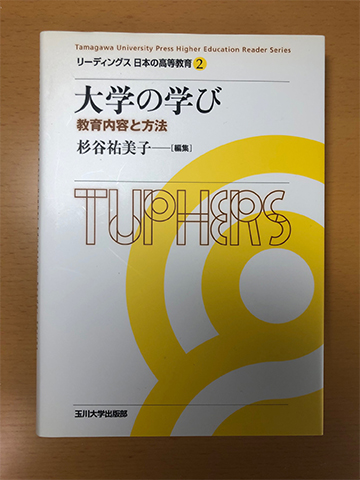
This book compiles and explains key literature in university education research.
This document organizes key issues related to university learning and the influence of learning.
The first-year course I currently teach, "Basic Seminar I," is also a practical research opportunity for me. While first-year education typically focuses on teaching the fundamentals of future learning, such as report and thesis writing, in this course, students themselves set themes related to educational issues and conduct research, studies, and thesis writing. The goal is for them to acquire essential attitudes and academic skills for university learning, such as clarifying questions, considering them based on facts, and relativizing their own ideas. The content may be somewhat challenging for first-year students who have just graduated from high school, but I believe they are well capable of handling it. In my opinion, many students who aspire to Department of Education have a positive view of and have adapted to "school education," where learning progresses based on given themes. That is precisely why I want them to broaden their perspectives, relativize their own experiences and ways of thinking, and gain experience in finding their own questions and engaging in trial and error.
In addition, we regularly conduct surveys on the actual learning lives of university students in collaboration with education-related companies. In a survey conducted in 2021 during the "with COVID-19 period," a significant decrease in perceived growth among second-year students who entered university during the pandemic was clearly evident. Furthermore, we had hoped that the spread of online classes, a new form of learning, might bring about some major changes in Japanese university education and the way students learn. However, currently, with some exceptions, Japan is seeing a return to traditional face-to-face classes, and online classes seem to be preferred for their convenience. Large-scale surveys are essential for these research activities, so a collaborative research approach is indispensable. We collaborate not only with faculty members from other universities but also with companies.
Educational sociology requires not only logical thinking skills, a quality common to all academic disciplines, but also a multifaceted perspective and flexible thinking that is not bound by conventional wisdom. Educational problems differ depending on the era and region, and their evaluation changes depending on the perspective. What is important is to be aware of the standpoint from which you are viewing the issue and to carefully consider what kind of solutions you will derive. The foundation for this is nothing other than objective empirical data. First and foremost, accurately grasp the facts—I repeatedly emphasize the importance of this to my students.
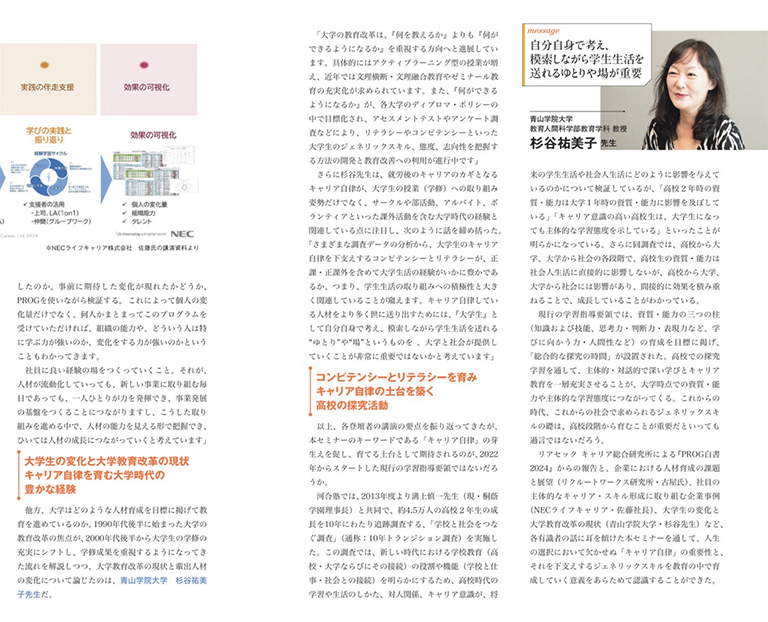
This is an article titled "Connecting Junior High School, High School, University, and Society Through Qualities and Abilities - Focusing on Competencies and Career Autonomy -" from the October/November issue of "Guideline" (pp. 14-15) (published by Kawaijuku).

When I first entered university, I didn't know anyone, and it took me a while to adjust to student life. However, I feel that the trial and error I went through and the efforts I made to expand my social circle during that time helped me grow significantly. The confusion and anxiety I felt as a freshman are the origin of my interest in first-year education, which I am now in charge of.
I majored in school education as an undergraduate, but when I entered graduate school, a leading expert in higher education theory joined the faculty, which prompted me to pursue a career in higher education. At the time, research in higher education was still in its early stages, but I believed it held the potential for significant change and the influence it could have on schools and society. However, looking back now, I think I had a vague sense of concern about higher education even earlier. When I was in high school, I wanted to go on to graduate school if I were to go to university, and this stemmed from my discomfort with the academic credentialism values that were deeply rooted in society at the time. I resisted the idea of going to university simply to obtain a degree and enter a prestigious university, and I had a strong desire to personally confirm and prove the "meaning of studying at university." This strong desire led me to graduate school and to my current research.
I have ample opportunities to directly interact with students by actually teaching numerous classes and seminars at the university, which is the subject of my research. I am also involved in the management of the faculty and graduate school. I believe there are not many cases where a researcher in higher education is affiliated with a private university faculty and is actively engaged in frontline educational practice. The history of higher education research in Japan is relatively short, and since the establishment of specialized research institutions at national universities in 1972, it has mainly been advanced by researchers belonging to research centers. Setting research issues for university personnel to address themselves involves difficulties such as self-criticism and self-evaluation. However, in terms of being able to experience the realities on the ground and feel firsthand the real challenges that universities face, my current environment is arguably the best research environment I could ask for. It is precisely because I have the perspective of a faculty member who is directly involved that I am able to re-examine what a "university" is.

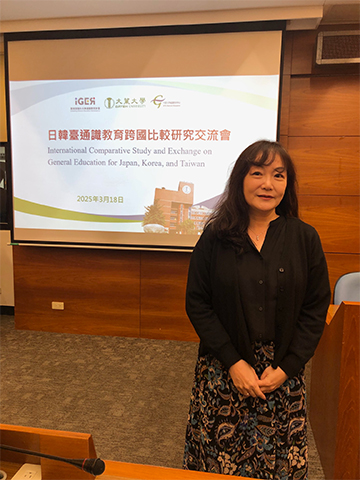
I have long studied liberal arts education at universities.
Recently, I've been participating in a comparative study of liberal arts education conducted by researchers from Japan, South Korea, and Taiwan. The photo was taken during a university visit in Taiwan.
Another issue I'm focusing on among the various challenges in Japanese higher education is how to support university students in truly becoming "university students." University learning differs from high school learning in that it requires a more proactive attitude. Recent educational reforms have emphasized learning that promotes proactivity, such as active learning, but at the same time, there has been an increase in students who remain passive "students." Rather than viewing this trend as a "change in the temperament of young people," we need to look at external factors such as the learning environment and the educational system, and carefully consider to what extent universities should provide support.
Another major challenge is the "overcrowding of the curriculum." Ideally, universities are designed for students to systematically deepen their learning over four years. However, in reality, factors such as the earlier start of job hunting mean that students have limited time to dedicate themselves to their studies. As a result, the number of courses students take up to their third year is high, the learning density in each class decreases, and it becomes difficult to engage in in-depth learning that involves working on assignments over a long period of time. While a selection of courses and a review of the curriculum are needed, these alone will not provide a fundamental solution. It is necessary to spread the understanding that university education should be enriched over four years, not only within educational institutions but also throughout society.
In recent years, universities have changed dramatically since I was a student, thanks to advances in educational reform. For example, back then, there were no syllabi, and course evaluations were only just beginning to be introduced at some universities. While it is progress that the tools to support these educational and learning activities are in place and that "learner-centered" education is being promoted, accurately and fairly measuring learning outcomes remains difficult. In particular, in academic fields of higher education that involve deep consideration of abstract concepts and complex issues, it is difficult to evaluate them due to their characteristics, and I fear that there is a tendency to focus only on measurable items.
On the one hand, while the evaluation of universities in today's society is gradually changing, it still seems to be heavily skewed towards limited indicators such as academic ranking and name recognition, with the quality of educational content and programs being given a backseat. As someone who studies the ideal form of higher education, I strongly hope that societal values will change so that more emphasis is placed on "what and how one learns at university, and how one thinks about and chooses one's own life." I also hope that high school students will make good use of various information to choose their career paths appropriately and study diligently at university.

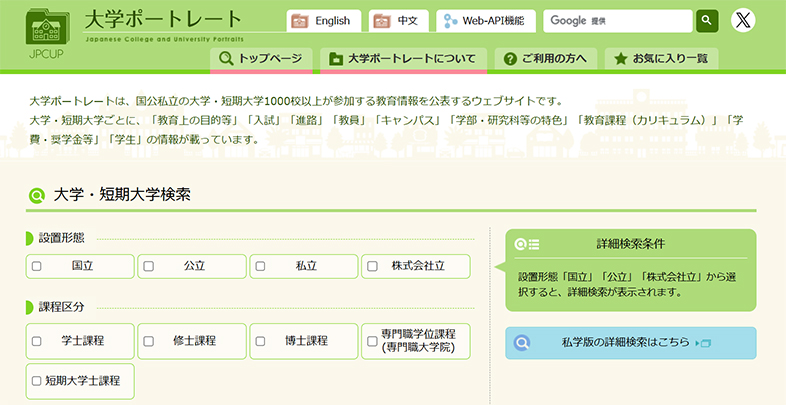
University Portrait is a website for publishing and utilizing educational information from universities.
As a member of the Stakeholder Board, I have offered suggestions for improvement. I hope this will be helpful when you are making career choices.