In the world we live in,
From issues close to us to issues that affect all of humanity,
There are many different problems.
The current situation and truth that are surprisingly unknown,
Our proud faculty members offer interesting insights
We will reveal it.
My research focuses on Kabuki, a classical Japanese performing art, primarily from the late Edo period through the Meiji and Taisho eras. Born into a family of Shinto priests, I grew up surrounded by the familiar sights of festival dances. From a young age, I experienced the exhilaration of watching performances with my neighbors during festivals. Although I was interested in Kabuki, I lived in Niigata Prefecture until high school, so I didn't have many opportunities to visit a theater. My first experience seeing a performance was during my second year of university. I still vividly remember the impact that day had on me. I was instantly captivated not only by the entertainment value of the play, but also by the experience of the entire theater uniting and sharing the same emotion, including the audience members known as "Oomukou" who enthusiastically shouted out the actors' stage names from the back seats. This experience resonated with my childhood memories, and my desire to learn more about this world led me to pursue research in this field.
Kabuki, which originated in the early Edo period, was originally a form of entertainment accessible to ordinary people. Edo-period stages were small theaters, much smaller than modern theaters, and the audience was closer to the performers. The former Konpira Grand Theater "Kanamaru-za" in Kagawa Prefecture retains much of the atmosphere of that time. Known as the oldest theater in Japan, it still hosts the "Shikoku Konpira Kabuki Grand Performance" every April, featuring professional kabuki actors.
Kabuki underwent a major transformation triggered by its contact with Western culture from the late Edo period to the Meiji era. Following the trend in Western countries to regard arts such as opera as highbrow, a "theater reform movement" arose in Japan, advocating for the need for a high level of formality in Kabuki as well. Due to national policy, plays with vulgar content disappeared, and actors' performances and behavior were required to be dignified. In this way, Kabuki was elevated to the status of a highbrow art form, leading to its current form.
However, some theaters did not follow this trend and continued to maintain their accessibility to the masses. Kabuki performances held in officially sanctioned, high-status theaters such as the Kabuki-za were called "grand plays," while kabuki as a form of entertainment more accessible to ordinary people was called "small plays." Small plays were smaller in scale, closer to the original kabuki, with a more intimate setting between the audience and the stage, and affordable ticket prices, attracting large audiences from the Edo period to the Meiji period. However, they gradually declined after the Taisho period. A major factor in this decline was the emergence of motion pictures (movies). Because small plays were aimed at the masses, they were greatly affected by changes in the tastes of the general public. Today, remnants of this can be seen in popular theater.
I am pursuing my research into Kabuki through the lens of smaller, more popular forms of theater that were enjoyed by the common people. Originally, during my graduate studies, I intended to study Kabuki audiences, but I was unsuccessful. Around that time, a professor told me that "smaller theaters actually attracted more audiences than larger theaters," which shocked me. Since then, I have been fascinated by these smaller, more popular forms of theater and have continued to research them.
*Constructed in 1835 (Tenpo 6), designated as a nationally designated important cultural property.
Kabuki research materials include theater-related documents such as scripts and playbills, paintings, publications, and ancient documents, as well as essays, diaries, and memoirs by ordinary people. Among these, I frequently consult newspaper articles and official documents from the time, which are held in institutions such as the National Diet Library and the Tokyo Metropolitan Archives. Newspapers began to be published in Japan during the late Edo period, and many were published during the Meiji era. There are abundant articles written not only about major theaters but also about smaller theaters, and it is no exaggeration to say that they are a treasure trove of materials.
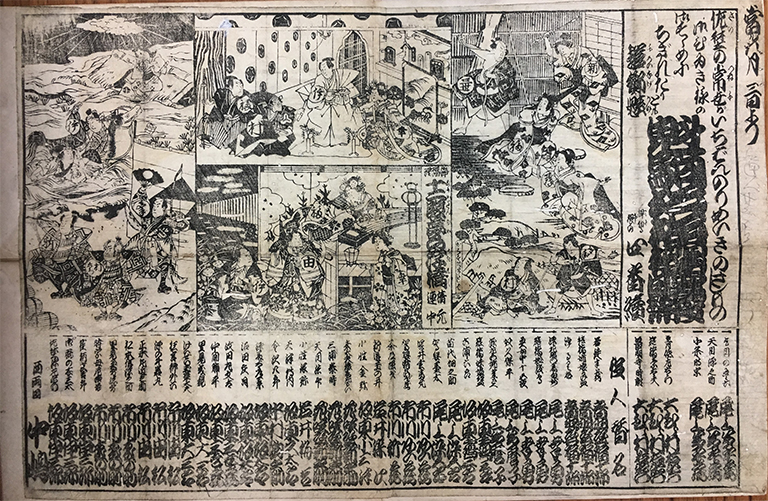
A playbill for the small theater "Nakajima" in Ryogoku, from around the beginning of the Meiji era (Kazō Sato)
The time I spend searching for and deciphering these documents is a moment of pure bliss for me. As I flip through the papers and try to imagine the lives and thoughts of the people of that time, I feel a sense of joy as if I've touched the atmosphere of that era. For example, at the Tokyo Metropolitan Archives, I found a petition from 1887 (Meiji 20) to build a small theater in Asakusa Park (near present-day Senso-ji Temple). From the wording, which aimed to "improve theater" in accordance with the intentions of the government at the time, and the name "improved training stage," I could read about the strong desire and ingenuity behind gaining permission to establish the theater. From the accompanying drawings, I was also able to glimpse what the theater was envisioned to look like at the time. The moment I decipher the documents, build up my thoughts, and arrive at my own answer is the real thrill of research.
When reading documents, I value maintaining a neutral perspective, free from preconceptions and fixed ideas. I had an experience as an undergraduate where I made arbitrary interpretations, and a professor told me, "Reading many documents is important, but..." ReadfruitpastGi I was once told, "You shouldn't do that." I learned from that mistake that a single misinterpretation can lead to unexpected distortions. Since then, I have made it a point to review as many sources as possible and strive to maintain objectivity while keeping a fair and impartial perspective.
Currently, I am particularly focused on the research of a female kabuki actress named Ichikawa Kumehachi. During the Edo period, there were troupes of female actors called "Okyogenshi" who performed kabuki for women in the Ooku (women's quarters) of Edo Castle and the inner quarters of daimyo residences, where men were forbidden. Even after the Meiji era began, some Okyogenshi continued to perform kabuki in the city, but the theaters they could perform in were limited, and until the mid-Meiji period, they were usually unable to perform with men. Therefore, in 1876, Kumehachi and her colleagues petitioned the then Tokyo Prefecture to allow the establishment of a theater for female performers. In their petition, they included wording to the effect that they wanted to contribute to society by using the profits from the plays to create a place for girls' education. This is an interesting document that conveys the position of Kumehachi and others at the time, who thought that they would not be accepted unless they applied for such additional conditions, unlike men.
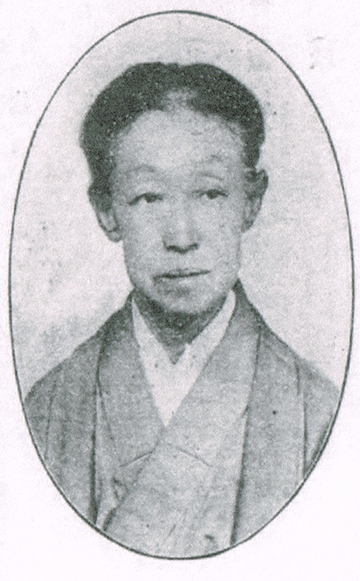
Ichikawa Kyūjōhachi (from "Actresses' Guide" edited by Iguchi Masaharu, Engei Gahosha, 1912, held by the National Diet Library)
Furthermore, she became a disciple of the renowned actor Ichikawa Danjuro IX and was famous as one of the most outstanding female actors. My reason for delving into her life is to explore the reasons why her acting skills were so highly regarded, and also because there are aspects of her story that move me as a fellow woman. I want to touch upon the "strength to live" of this woman who bravely survived adversity—it is with this thought in mind that I am undertaking this research.
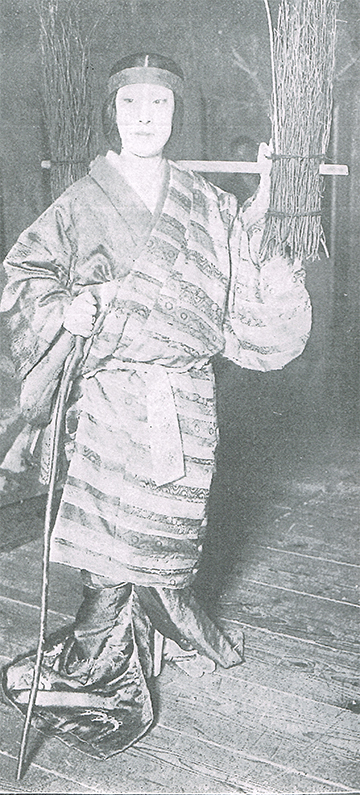
Ichikawa Kyūjōhachi's "Yamauba" (from the Kotobuki-za performance of "Shinkyoku Yamauba" in May 1907, published in the June 1907 issue of "Engei Gahō")

I feel that Japan tends to have a somewhat weaker interest in its own culture and history compared to other countries. I sometimes think that students from other countries are more passionate about learning about Japanese culture than Japanese students. An Italian friend of mine who teaches at Cambridge University in England specializes in Edo period literature, including kana-zōshi. She also holds seminars on "honkoku," which is the process of converting "kuzushiji" (cursive script) into modern typefaces, and when I was invited to teach one of these seminars, I was surprised by the large number of foreign students who were interested in and eager to learn about old Japanese, which is difficult even for Japanese people to read.
If, when asked by a foreigner, "What is Kabuki?", we are unable to answer, wouldn't that be a cause for concern for those of us living in Japan? At the same time, I also feel the importance of more actively promoting Japanese culture and art to the international community. If, through research and education, we can widely convey the little-known charms of Kabuki to the world and create opportunities for many people to experience "authentic Japanese culture," nothing would make me happier.
For high school students interested in Department of Comparative Arts, there's something I'd really like you to try. While you can access art almost anywhere these days, I encourage you to go out, visit theaters, museums, and cinemas, and experience live art firsthand. You'll surely gain something from those experiences.
Nurturing your heart through art and deeply exploring your passions will eventually accumulate as knowledge and lead to inner richness. This will become a vital foundation that guides you to a more fulfilling life. In Department of Comparative Arts, as you engage with art from multiple perspectives and delve into the question of "what is true beauty," you will naturally acquire the processes of thought and the skills to refine your sensibilities. I hope you will take your time to cultivate your critical thinking and empathy.

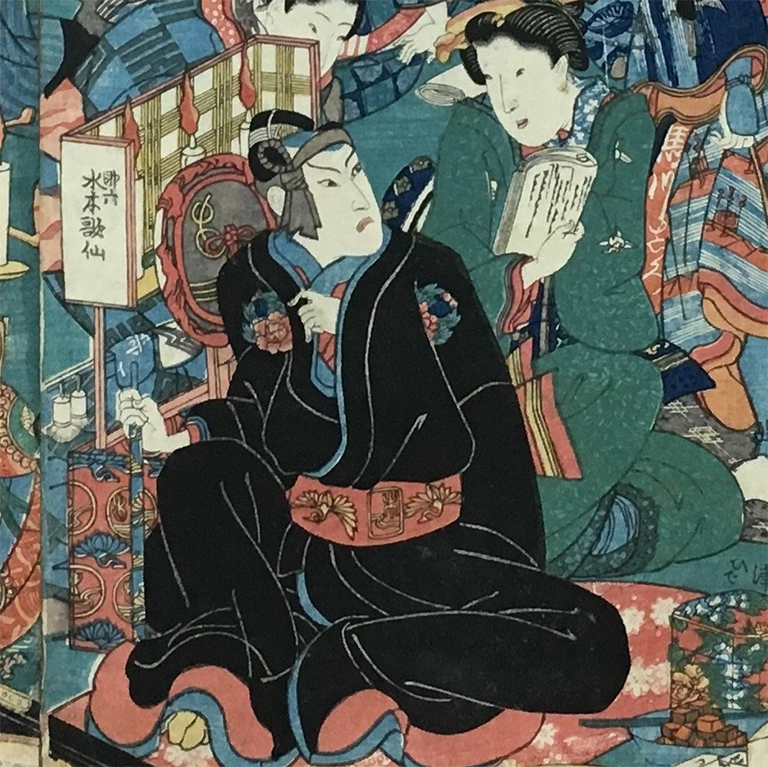
Kasen Mizuki, a Kyogen performer dressed as Sukeroku (part of "The Play of Sukeroku as a Child" by Ichiyusai Kuniyoshi, owned by Sato Kasumi)