Aoyama Gakuin University faculty members:
He is an uncompromising researcher.
Aiming for a prosperous society,
We are always conducting cutting-edge research.
We will explore the research results of our faculty members who are shaping the future.
* Aoyama Gakuin University Institute for Integrated Projects, 2020-2024 Project
Japan Society for the Promotion of Science, Grant-in-Aid for Scientific Research (B) (General), Project Number: 23K20342
What is a mixed methods study?
This research approach utilizes both qualitative and quantitative data to comprehensively elucidate complex phenomena. By having researchers move back and forth between quantitative and qualitative data during their analysis, it becomes possible to understand and interpret "what is the essence of the phenomenon" and "what is happening" in a deeper and more three-dimensional way. Integrating two types of data with different properties can lead to new perspectives and discoveries.
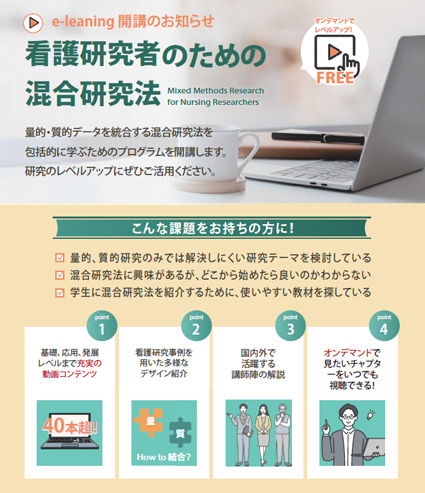
Key points of the "Mixed Methods Research e-Learning" course for nursing researchers
This e-learning program was developed primarily for researchers and graduate students in the field of nursing. Traditionally, opportunities to systematically learn "mixed methods research" have been limited, and the difficulty of self-study has been pointed out. This program is designed to address these challenges in the field. In its development, surveys were conducted with nursing researchers in Japan and experts overseas, and the program systematically covers important themes such as "research design," "integration of qualitative and quantitative data," and "thesis writing," which learners often find difficult to understand and master.

Explore the topic with your teacher

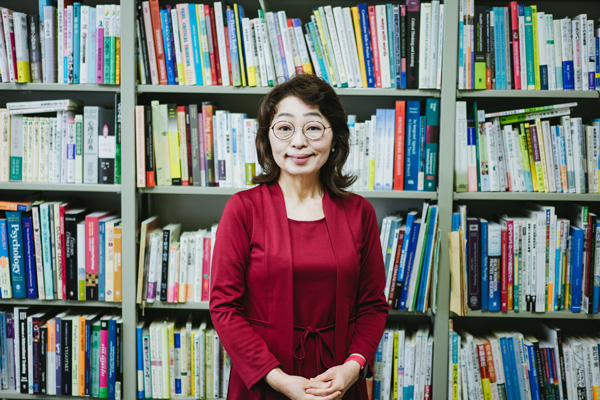
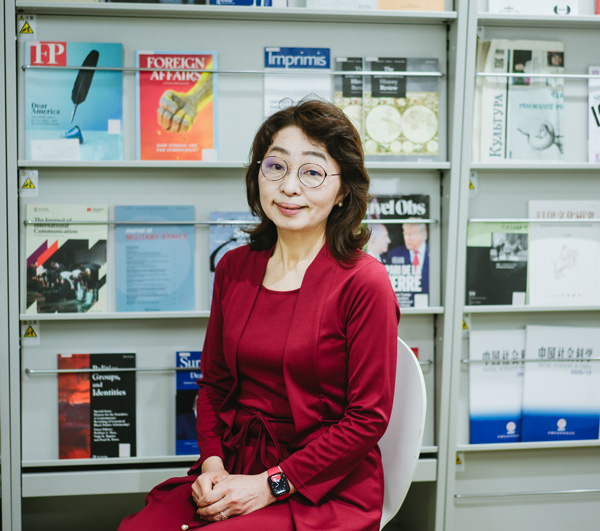
Professor Naoko Kakui
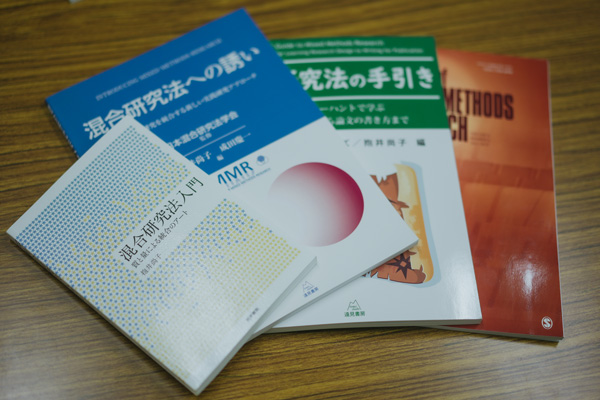
Graduated from the Department School of International Politics, Economics and Communication Department of International Economics International Politics and Economics, Aoyama Gakuin University. Completed a Master's program in Educational Counseling at the University University of San Diego. Completed a Ph.D. in Educational Psychology at the University of Hawaii. After working at a foreign financial institution, served as a research assistant at the University of Hawaii's School of Social Work and the University of Hawaii's Cancer Research Center. Joined the Faculty School of International Politics, Economics and Communication, Aoyama Gakuin University as a full-time lecturer in 2002, and has been an assistant professor and associate professor since 2010. Specializes in mixed methods research, multicultural health communication, and intercultural communication. Major publications include "Introduction to Mixed Methods Research: The Art of Integration through Quality and Quantity" (Igaku-Shoin, 2015). Selected as one of the "Top 2% of the World's Most Influential Researchers" in 2025.
Mixed methods research is a research approach that integrates two methods: "quantitative research," which uses numbers and statistical data, and "qualitative research," which deeply captures individuals' experiences and narratives through interviews and other means. It is a relatively new research approach that has seen rapid theorization since the 1990s and is also positioned as the "third methodological trend."
To use an analogy I often employ, quantitative research is like a snapshot from a "bird's-eye view" that surveys overall trends, while qualitative research is like a video from an "insect's-eye view" that concretely depicts what is happening on the ground. Combining these different perspectives is crucial for understanding complex societies and human challenges, as it allows for a more multifaceted and deeper understanding of phenomena.
My starting point lies in my experience as a research assistant at the University of Hawaii Cancer Research Center (USA) in the late 1990s, where I participated in a research project on complementary and alternative medicine for cancer patients.
In medical research, quantitative research that places a strong emphasis on objectivity is the mainstream, but in this project, we conducted not only a large-scale questionnaire survey of several thousand people, but also interviews with over 140 cancer patients. I myself visited the homes of about 80 patients and conducted interviews. In the process, I was deeply shocked to realize that each person, who had previously been treated merely as an "ID number" in the data, actually possessed a very rich and unique life story, as I came face to face with them and touched upon their inner selves. It was like a black and white photograph suddenly coming into color, and it left a strong impression on me.
Through this experience, I realized that there are aspects that cannot be captured by quantitative research alone, and at the same time, I became completely fascinated by the power and potential of mixed methods research.

That's my view. In the world of research in the past, there was a long-running "paradigm debate" about whether quantitative research, which aimed to discover objective laws, or qualitative research, which emphasized understanding subjective experiences, was superior. There was even a time when using both methods in a single study was considered taboo.
However, complex real-world problems cannot be adequately grasped by either approach alone. Mixed methods research takes a stance of allowing these different perspectives to coexist and complement each other, rather than pitting them against one another. By integrating the overall "structure" shown by numerical data with the "meaning" and "process" revealed by narratives, aspects that were difficult to see with a single method come to light. It is characterized by the emergence of new meanings and understandings that go beyond "1+1=2" to "1+1=3," which is professionally called "meta-inference."
Mixed methods research encompasses several representative research designs, depending on the order in which "quantitative" and "qualitative" data are combined. These are called basic designs. For example, in my first research project at the University of Hawaii, I adopted an approach called an "explanatory sequential design," where quantitative data was collected and analyzed first, and then qualitative data was added based on those results to deepen the understanding of the quantitative research findings.
In addition, there are various other approaches, such as "convergent design," which aims for a comprehensive understanding of a phenomenon by independently and simultaneously collecting quantitative and qualitative data and comparing and relating the results; and "exploratory sequential design," which collects and analyzes qualitative data, generates hypotheses based on the insights gained, and quantitatively tests them with a large sample size.
It is important to logically design the entire research project by appropriately selecting or combining these basic designs according to the research objectives and questions.

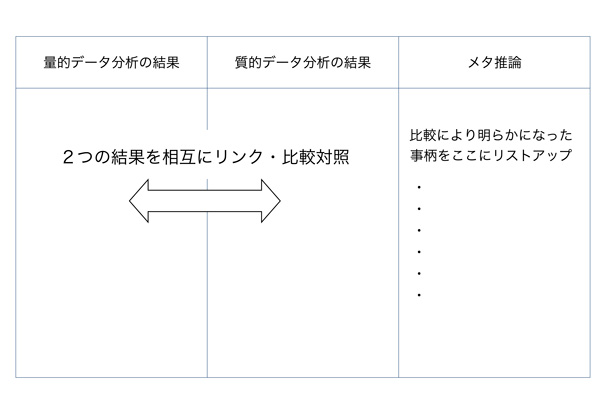
The characteristic of mixed methods research lies in its ability to integrate quantitative and qualitative data, thereby revealing aspects of phenomena that would be difficult to see using each method alone. This integration is analyzed using tables and figures called "joint displays," and the results are visualized.
In integrated analysis, it is particularly important to consider situations where there are inconsistencies or discrepancies between quantitative and qualitative data. For example, when I participated in a nursing research project on "tele-nursing," where patients are monitored remotely, one patient, despite improvements in physical metrics, seemed depressed, comparing their current state to their healthy self. On the other hand, there were also narratives indicating that despite numerically requiring continued treatment, the support of tele-nursing helped maintain a positive outlook. Thus, objective "physical condition" and the "emotional state" experienced by the individual do not always coincide.
In mixed methods research, this discrepancy is not treated as a mere exception, but rather as a new question: "Why does this difference occur?" By accumulating such questions, it becomes possible to understand the phenomenon more deeply.
Joint display is a method for integrating the results of quantitative and qualitative research, playing a crucial role in organizing and clearly presenting often complex research findings. In recent years, it has also been used in planning quantitative and qualitative data collection, and even in integrated analysis.
Particularly groundbreaking is the role of joint display as an integrated analytical tool. Traditionally, the integration of "quantity" and "quality" in mixed methods studies was typically explained through written descriptions in the discussion section of the paper. However, the importance of visually representing this integration has increased, making joint display an indispensable element for data integration.
A major contributor to this development was the late Professor Mike Fetters (University of Michigan), former co-editor-in-chief of the Journal of Mixed Methods Research and my research collaborator. Professor Fetters proposed a format that integrates the comparison of quantitative and qualitative data with the meta-inferences derived from them. This made the relationship between the two easier to grasp visually, and clearly demonstrated the value of integration, sometimes referred to as "1+1=3".
Currently, the formats of joint displays are also diversifying. For example, a multi-layered representation using a circle has been proposed, where the results of quantitative data analysis are placed in the center of the circle, the results of qualitative data analysis (themes and specific narratives) are placed around it, and meta-inferences are layered on the outside.
Thus, joint displays are now evolving beyond simply being a method of presenting results; they are also developing as a framework of thinking that supports the entire research process (planning, analysis, and reporting).

Nursing practice requires complex work that involves addressing both the emotional (qualitative) and physical (quantitative) aspects of patients.
Therefore, in nursing science, it is considered important to understand not only objective numerical data showing "what is effective," but also "why it is effective" and "in what people and situations it is effective," including the narratives of those involved and the context of the field. Against this backdrop, interest in mixed methods research has been growing globally among nursing researchers and practitioners in recent years.
On the other hand, opportunities to systematically learn mixed methods research in educational institutions are still limited, and there are currently insufficient opportunities for practical learning. This is also true in Japan. Therefore, our research team has developed an e-learning program that can be used to study in spare time, allowing busy nursing researchers and graduate students to learn step by step from basic to applied methods.
In developing this program, we conducted surveys of nursing researchers both domestically and internationally to carefully understand their learning challenges and needs. Based on these findings, we incorporated the Japanese concept of "Shu-Ha-Ri" (守破離), a philosophy of learning, into the program's structure.
The learning process is designed in stages: first, learn the basic research design framework (Shu), then deepen your understanding by applying it (Ha), and finally, become able to flexibly use it according to your own research objectives (Ri). What we emphasized most here was to give nursing researchers and practitioners, who are required to strictly adhere to guidelines in the medical field, the mindset that "once you've mastered the basics (Shu), you can design your own research more creatively." Inaddition, during the survey, we received many comments that "there are no readily available instructors or mentors to consult when questions arise." To address these issues, we plan to implement a "mentor function that allows you to ask questions anytime, anywhere" using conversational AI. Through this, we aim to create an environment where learners can deepen their learning continuously without feeling isolated.

Many of the events that led me to discover mixed methods research and pursue a career in research were initially quite coincidental. One such event was when my mentor encouraged me to conduct direct interviews with patients.
However, cherishing those experiences that deeply moved me and continuing to deepen my own questions has ultimately led to my current research.
Furthermore, conducting interviews in a different cultural environment, using English which is not my native language, and on the subject of "complementary and alternative medicine," which is outside my area of expertise—at first, I was absolutely terrified. But because I mustered the courage to jump into this opportunity, I was able to learn an immeasurable amount. I am now incredibly grateful for the courage I had to take that first step. In the future, I believe you will all encounter various people and events through chance encounters. If you come across something that deeply moves you, I encourage you to be brave, seize that seed, nurture it carefully, and continue to challenge yourself little by little. If you do so, you will suddenly realize how far you have come.

*The affiliations, Position, and research topics of the individuals listed are as follows:
This information is generally based on the time of the interview.