AGU RESEARCH

Columns that reveal the world
- Getting up close and personal with the researchers -

In the world we live in,
From issues close to us to issues that affect all of humanity,
There are many different problems.
The current situation and truth that are surprisingly unknown,
Our proud faculty members offer interesting insights
We will reveal it.

  • College of Literature Department of English
  • Published on 2026/05/12
  • Analyzing the "reception" of authors and their works from multiple perspectives, and re-examining the social role of literature.
  • Professor Yuko Matsui
  • College of Literature Department of English
  • Published on 2026/05/12
  • Analyzing the "reception" of authors and their works from multiple perspectives, and re-examining the social role of literature.
  • Professor Yuko Matsui

Analyzing Scott's poetry and historical novels from the perspective of "reception."

My area of expertise is English literature and culture. In particular, I focus on Scottish writers, especially Walter Scott, a leading figure of the 19th century, as well as other Scottish writers from the United Kingdom with diverse institutions and cultures. I examine their construction of unique character portrayals, narrative techniques, and the expression of multiple identities, recognizing them as important precedents in today's world where diversity is highly valued.

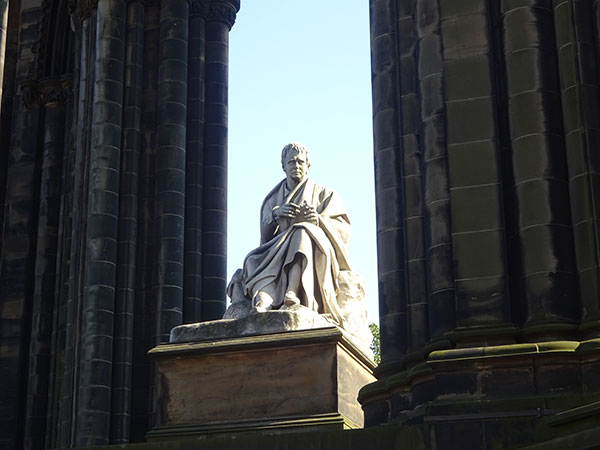
A statue at the base of the Scott Monument in the city of Edinburgh


Scott wrote works such as the epic poem "The Lady of the Lake" and the historical novel "Ivanhoe," set in medieval England, and exerted a tremendous cultural influence both domestically and internationally, including in Japan, during the first half of the 20th century. His works set in Scotland, including "The Lady of the Lake," led to the enduring popularity of tartan. The terms "Wars of the Roses" and "freelance," still used today, are said to have become widespread after their use in "Ivanhoe," and some researchers see the influence of this work not only on chivalry and interest in the Middle Ages, but also on attractions like carousels in amusement parks. After his death, a monument approximately 61 meters tall, considered one of the largest in the world dedicated to a writer, was erected in the heart of his birthplace, Edinburgh. Despite all this, he is a writer who has been almost completely forgotten in modern times.


Therefore, my initial interest lies in comprehensively examining the context in which Scott's poetry and historical novels were received and the role they played in contemporary society, and in exploring the realities of their "reception" and the mysteries of their dramatic transformations since the 20th century. In the 19th century, numerous adaptations of Scott's works were produced, including operas and stage productions, and spin-off works were also written. Scenes and characters from his works became the subject matter for many famous painters and the then-invented photography. Furthermore, his residence and the settings of his works became destinations for so-called "pilgrimages," attracting many "literary tourists" not only from within Japan but also from Europe and North America. Including such instances where readers physically and bodily engage in the concretization of his works, I am considering the relationship with the general readership suggested by diverse publishing formats, as well as criticism in academic journals and the positioning of his works in various educational settings such as elementary schools and universities.


From this, it becomes clear that Scott's works, through these diverse receptions, served as a circuit for readers of the time to forge imaginative relationships with real places, understand the present while layering memories of the past, and envision the future, as well as a catalyst for communication among readers. This is an indispensable role that literature has played across generations, but in Scott's case, I believe that his status as a writer of historical novels, a hybrid genre in which historical fact and fiction are intricately intertwined, also facilitated this kind of reception. On the other hand, this very reason led to him later being categorized as a "popular author" or "mass author," delaying academic research and contributing to the dramatic decline in his recognition in modern times. Therefore, I would like to further explore the contemporary significance and the nature of historical novel criticism by grasping the reality of the diverse receptions in the 19th century that are also connected to contemporary phenomena, and by analyzing the characteristics of Scott's narrative techniques and characterization in his historical novels, along with considering their social role. As part of this, I have recently been attempting an approach from the perspective of "environment" regarding the relationship between land and people in Scott's activities and works.

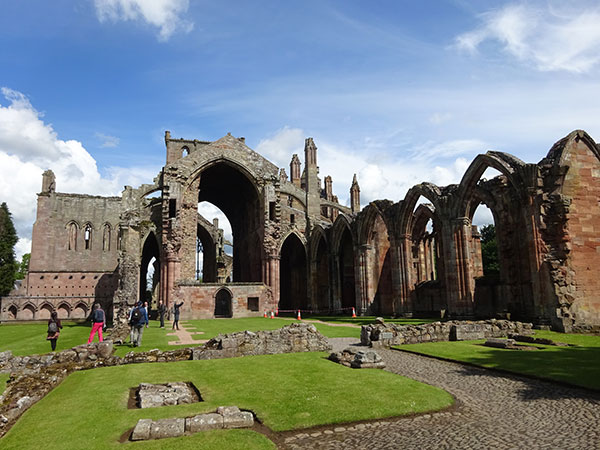
Melrose Abbey, a ruin in the Scottish Borders region, was one of the destinations for "literary pilgrimages" in the 19th century.

Scottish literature is another context

Another important perspective when interpreting Scott is that he was a Scottish writer. Following the personal union of James VI and I in 1603, the Scottish and English Parliaments united in 1707 to form the Kingdom of Great Britain, but both regions continued to maintain their own laws and school systems. Scott was a writer who attempted to imagine this multi-ethnic nation of Britain, and from this perspective, I believe that reading Scott's works has contemporary significance.


Even with the same author, rereading their work from a Scottish perspective reveals new facets. For example, J.M. Barrie, famous for Peter Pan's "Peter and Wendy," initially rose to prominence with a collection of short stories written in Scots, one of Scotland's major languages. These works, modeled after Barrie's hometown of Kirlimuire, are rarely discussed in general histories of English literature, but they are indispensable when considering Scottish literature and culture at the end of the 19th century. Barrie also wrote Sherlock Holmes parodies and was friends with Arthur Conan Doyle, who was born in Edinburgh. R.L. Stevenson, author of "The Mysterious Affair of Doctor Jekyll and Mr. Hyde," which, like Doyle's Holmes series, is set in London, was also from Edinburgh. Rereading both works from this perspective reveals subtle elements of their hometowns. In addition, there is no end to the discoveries, surprises, and fascination to be found in the ingenious representation of multiple identities, which is common among Scottish writers, and the character portrayals that embody Scottish culture.


I believe that free and new perspectives, unconstrained by conventional viewpoints, and the insights gained from them, are fundamental to academic endeavors. However, in the history of English literature, the former cultural influence of the "forgotten writer" Scott, and the existence of Scotland as another context, also leads to the historicization and relativization of the institution of "English literature" itself in which I belong. This is something I pay particular attention to when structuring the lectures I teach.


In our seminars, we sometimes discuss fantasy works by Scottish author George MacDonald or Barrie's "Peter and Wendy." In these cases, we not only focus on the Scottish authors, but also consider three fundamental perspectives—class, gender, and race—that are essential when reading British novels in particular. For example, some students analyze Wendy in relation to the ideal woman of the Victorian middle class and imperial values, while others examine the representation of Tiger Lily and Native Americans, or consider Mr. Darling from the perspective of masculinity. Furthermore, even when reading the same work, students' presentations are never the same, such as analyzing the illustrations in various editions of "Peter and Wendy" or comparing multiple film adaptations. I believe this kind of learning will provide hints for considering contemporary society and a single event from multiple angles.

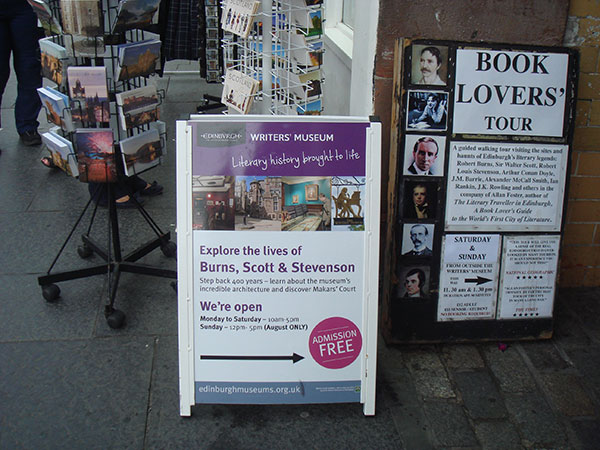
A sign for the Writers' Museum and a literary tour of places associated with Scottish writers.

An unforgettable experience gained only through continuing research at Aoyama Gakuin University.

I've loved reading books since I was little, but the one I remember most vividly is reading the translation of "Mary Poppins." It was part of a collection of world literature for young people, and I started reading it simply because it was there. But in an instant, I was transported to 17 Cherry Blossom Lane, and I couldn't stop reading even when I was invited to dinner. It was a place I'd never been to, and it depicted things that couldn't possibly happen, yet it felt as if I was experiencing it alongside the characters, as if another world had appeared before me. It was an experience of the magical power of words. It sparked my interest in the English language and Britain, and I think that paperback of "Mary Poppins," which was the first book I bought when I started learning English, is one of the starting points that connects me to where I am today.


One of the things that drew me to literary studies was a class I took during my university days. Every week, we were given only a text with the author and title hidden, and we had to submit a report. Starting from scratch with no clues, I mobilized all my historical and cultural knowledge and imagination to engage with the work and decipher it, and I realized the joy of "active reading." It was around this time that I read Scott's first novel, "Waverley," and was amazed by the scale of the social image it presented and the complexity of the historical perspective unique to Scottish writers. Afterwards, since Scottish literary studies were not very widespread in Japan at the time, I continued my research at a graduate school in Scotland.


Since embarking on a research career, I have come to pay particular attention not only to the content written in a work, but also to the "unwritten elements" that make up the narrative. This includes, of course, "reading between the lines," but also to reading literary works as part of a broader network of language to which they belong, or considering the overall structure that supports a particular expression. In this sense, the interpretation of literary works is connected to "reading" and understanding society and culture as texts in general. Naturally, physical conditions and the existence of readers are also indispensable elements that make up a work. For example, the spread of inexpensive publications is supported by the material prosperity of society, general education, and the development of printing technology and means of transportation, and the expectations of readers who pick them up vary, from entertainment to a thirst for knowledge, or criticism of society based on that knowledge. Keeping these things in mind when interpreting a work is important in terms of considering the social role of literature, and the attitude of continuously asking "what are the factors that make up what is here and now" is applicable not only to literature but also to many academic fields.


My research on the reception of Scott has also brought some delightful encounters. In relation to the popular readership that emerged at the end of the 19th century, I had focused on the importance of the "cheap editions" that were widely published at the time. However, because they were inexpensive, mass-produced editions, there were few examples of them being held in libraries, and opportunities to see them were limited. But, by chance, I found one while searching for other materials in the stacks of the old library on Aoyama campus. In a dimly lit corner of the stacks, the moment I opened "Waverley," with its rough paper and tiny letters densely arranged in two rows, I felt as if I had traveled back in time and become one of the readers who picked it up out of a thirst for knowledge. Furthermore, I was fortunate enough to come across "Umeboshi Yokun," one of the Japanese translations of "Ivanhoe." Scott, along with Shakespeare and Bulwer-Lytton, was one of the three British authors whose works were first translated during the Meiji era, and this book, along with the works of these two, was held in Aoyama Aoyama Gakuin Archives (now Aoyama Museum). This is an unforgettable experience, unique to our university, which has a 150-year history in English language education and English literature research.


On the other hand, I am also grateful to be involved in a pioneering educational program, which is the first of its kind in Japan. The Department of English and American Literature Graduate School of Literature our university Environmental Humanities Program 2024 (established in fiscal year) This also leads to a re-examination of my previous research from an environmental perspective, as an effort to respond to global environmental problems.

Waverley Station in Edinburgh, featuring quotes from Scott's works.


High school students are likely interested in a variety of seemingly unrelated things. First, try to find the connections between them yourself. If those connections involve literature or English, the Department of Department of English College of Literature will be a meaningful and stimulating learning environment where you can discover new aspects by deeply exploring the core of those connections. Enjoy your intellectual adventure that leads to diverse perspectives and liberation on society and yourself.

Related articles

  • Yuko Matsui, *Scott: The Man and His Literature* (Bensei Publishing, 2007)
  • The Japan Caledonia Society (ed.), "History and Culture of Scotland" (Akashi Shoten, 2008)
  • Keiko Fukuda, Naoko Ueno, and Yuko Matsui (eds.), *Possessed English-Speaking Texts: Ghosts, Blood, and Illusions* (Otowa Shobo Tsurumi Shoten, 2018).
  • Masami Yuki (ed.), "More Than Human Stories: Ten Sequences in Environmental Humanities" (Aoyama Gakuin University Research Institute Series) (Minerva Shobo, 2025)

Study this topic at Aoyama Gakuin University

College of Literature Department of English

  • College of Literature Department of English
  • Professor Yuko Matsui
Link to researcher information

Related Keywords

Related Content

  • College of Community Studies,
    Department of Community Studies
  • From "sensitivity" and "intuition"
    We aim to unravel the state of education and society and resolve issues.
  • Professor Hiroshi Nishijima
  • "Sociology of education" considers education in society. As we consider the relationship between education and society through themes such as music education, the approach spreads beyond time and region, and even the attitude toward how we should approach academic studies emerges. (Released in 2023)

  • Faculty of Law, Department of Human Rights
  • Exploring LGBTQ human rights issues from the field of law, with a focus on legal interpretation.
  • Professor Hiroyuki Taniguchi
  • Serious discussions on LGBTQ human rights issues began in Europe in the 1980s and spread globally, but the situation in Japan is still far from ideal. Professor Hiroyuki Taniguchi is addressing this issue from the perspective of legal interpretation, conducting research on the influence of international human rights norms on Japanese legal interpretation, keeping in mind its historical and social connections. Not only for LGBTQ issues, but for human rights issues in general, viewing them solely from the perspective of individual awareness and feelings will lead us further away from fundamental solutions. What perspective should we adopt?
    (Published in 2022)

  • College of Literature
  • The image of Taira no Kiyomori and the Genpei clan in the Tale of the Heike
  • Professor Shinichi Saeki
  • The 2012 NHK Taiga drama was "Taira no Kiyomori." While Taira no Kiyomori is portrayed as a hero in the drama, he is depicted as a "villain" in "The Tale of the Heike." This article explores the reasons behind this portrayal and the fate of the Taira clan through the lens of "The Tale of the Heike." (Published in 2012)

Related Content

  • College of Literature
  • A journey into the heart of literati painting
  • Associate Professor Sachiko Idemitsu

  • School of Business, Department of Marketing
  • Unraveling the mechanisms of the distribution system that intertwines economy, society, culture, and history
  • Professor Nobukazu Azuma

  • College of Education, Psychology and Human Studies
  • The connection between the world of sound and psychology
  • Professor Jun Shigeno