AGU RESEARCH

Topics that shape the future
- Closer look at research results -

Aoyama Gakuin University faculty members:
He is an uncompromising researcher.
Aiming for a prosperous society,
We are always conducting cutting-edge research.
We will explore the research results of our faculty members who are shaping the future.

  • College of Education, Psychology and Human Studies, Department of Education
  • Published on 2025/07/25
  • We have begun a joint research project with the Japan Kanji Aptitude Testing Association on "Learning Environments and Assessment for Cultivating Language Ability in the AI Era."
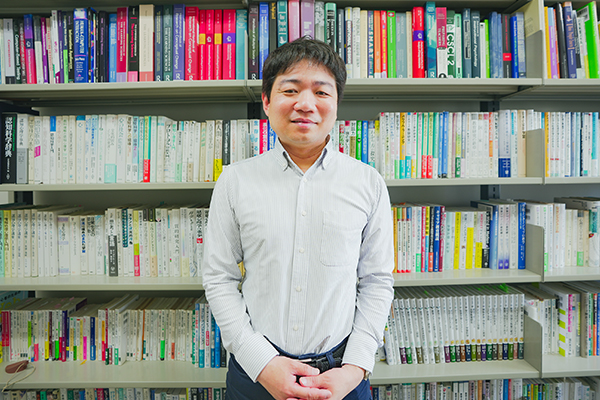
  • Professor Hironori Maskawa
  • College of Education, Psychology and Human Studies, Department of Education
  • Published on 2025/07/25
  • We have begun a joint research project with the Japan Kanji Aptitude Testing Association on "Learning Environments and Assessment for Cultivating Language Ability in the AI Era."
  • Professor Hironori Maskawa

TOPIC

The Aoyama Institute for Learning Science, led by Professor Hiroyuki Masukawa, has begun joint research with the Japan Kanji Aptitude Testing Association on "Learning Environments and Evaluation for Cultivating Language Ability in the AI Era," aiming to develop an AI system that fosters "language skills" through the revision process.

What is the Japan Kanji Aptitude Testing Association?

This organization conducts activities such as "promotion and support of the Japanese language and kanji," "research and studies on the Japanese language and kanji," and "development of Japanese language and kanji proficiency," through the implementation of the "Japanese Kanji Proficiency Test." Through activities that support the learning of the Japanese language and kanji, it aims to "contribute to the development of Japanese culture through the promotion of lifelong learning in Japan" (quoted from the association's philosophy).

Key points of the collaborative research

By combining research findings with practical services in educational settings, it becomes possible to measure the effectiveness of new educational methods, rather than limiting generative AI to merely a tool for acquiring knowledge, and instead utilizing it as a tool to deepen students' learning and improve their Japanese language proficiency.

Illustration: Arrow

Explore the topic with your teacher

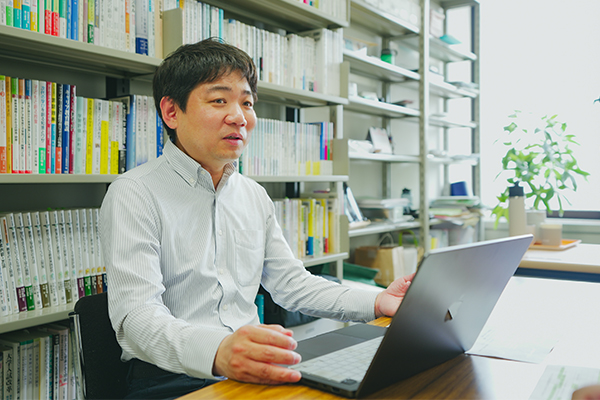
Professor Hironori Maskawa

College of Education, Psychology and Human Studies, Department of Education

Graduated from Department of Cognitive Science, Faculty of Information Science, Chukyo University. D. in Cognitive Science, Graduate School of Information Science, Chukyo University. After working as an assistant at the Department of Cognitive Science, Faculty of Information Science, Chukyo University, a lecturer at the Faculty of Education, Shizuoka University, an associate professor at the same Faculty, and an associate professor at the Graduate School of Shizuoka University, he became a College of Literature Department of Education professor at the University of the Sacred Heart in April 2017. Aoyama Gakuin University College of Education, Psychology and Human Studies Department of Education professor in April 2024. His specialties are cognitive science, learning science, educational technology, and cooperative learning. His publications include "21st Century Skills: New Forms of Learning and Assessment" (translation) and "Active Learning Techniques and Classroom Design" (co-author).

Learning science applies insights into human learning to education.

In the future, we will utilize advanced tools such as generative AI to further enhance learning.

AI is not just a tool for gathering knowledge, but also a support system for thinking through dialogue.

What are cognitive science and learning science as fields of study?

The field I research, "cognitive science," is the study of how humans perceive things and incorporate them into their knowledge. People from various research fields come together, primarily aiming to unravel the mysteries of "knowledge," that is, intelligence and learning. During my university years, I majored in cognitive science, and throughout my studies, I have continuously researched questions such as "how do people learn?" and "what kind of support is possible for better learning?"
The field of cognitive science encompasses not only school education but also all aspects of human intellectual activity in daily life and various situations. However, since the 1990s, there has been a surge in efforts to apply its findings to educational settings. "Learning science" emerged from this trend. Learning science places importance on the use of diverse technologies, including artificial intelligence (generative AI). Moving beyond the traditional framework of school education, the main focus of current learning science is to build better forms of learning by utilizing cutting-edge technologies such as generative AI.

Is it about pursuing new approaches to education in line with changing times?

Of course, social conditions change with the times, and I understand the idea that we need to reconsider the way we teach accordingly. However, considering the principles of human learning, I believe there is a way of teaching that better utilizes the strengths of human learning. I believe that the goal of school education going forward should not end with "what you know," but rather shift to "what new things you can do" by utilizing what you have learned. Specifically, this requires a shift from a "goal-achievement type" where educators set goals in advance, to a "goal-creation type" where learners themselves set goals, and from a "teacher-centered type" where knowledge transmission is the main focus, to a "learner-centered type" where learners learn independently.

Learning science is based on learning theories such as "how people learn" and "when people learn best." By combining decades of accumulated research with new information technologies, it becomes possible to design richer learning and educational environments. Through learning science, we hope to build goal-setting and learner-centered learning environments, and as a result, contribute to positive change in society.

This is an approach that aims for goal-setting and learner-centered education.

Because education is a field that everyone has experienced firsthand, discussions tend to be biased towards subjective opinions like, "This is what it was like in my experience." However, whether that experience was truly good education or whether there were any problems inevitably depends on subjectivity. As a result, I feel that there are many discussions based on individual feelings like, "This education was good for me." However, education is a field that should be scientifically verified. I believe that the role of learning science is to collect and analyze data on people's learning and clarify what is effective.

For example, in the medical field, it is common practice to collect numerous cases using different methods and scientifically compare and analyze them in order to measure the effectiveness of drugs and treatments. On the other hand, in the field of education, such quantitative comparisons are difficult, and until now, there has been a tendency to rely on the empirical rules of excellent educators. Education of the future will require that such experiences not be treated as knowledge that remains within the individual, but rather recorded and analyzed as data and made into a form that can be shared with the next generation of educators. My research goal is to clarify the ideal form of goal-setting and learner-centered education through this scientific approach, and to return the results to practice.

What prompted the joint research with the Japan Kanji Aptitude Testing Association?

As stated on their official website, the Japan Kanji Aptitude Testing Association operates with three main pillars: "Public Awareness and Educational Support Activities," "Research and Study Activities," and "Japanese Language Proficiency Development Activities," aiming to improve overall Japanese language proficiency, including expressive ability and vocabulary. As part of these activities, they approached us to explore the possibility of developing new service formats by applying insights from learning science, which led to this project.
Furthermore, this time, the use of generative AI is also included, and the "words" handled by the Japan Kanji Aptitude Testing Association and the "linguistic information" handled by generative AI are in the same domain. I think this was also a time when we wanted to explore new ways of learning that support learners' Japanese language abilities, without being bound by traditional teaching methods and flexibly incorporating advances in generative AI technology. In the field of cognitive science, including learning science, there is a long history of research into the use of AI, so I feel that various elements have come together at this time.

What are your expectations for collaborative research with companies?

The primary reason for conducting collaborative research is that I believe companies and organizations, by providing educational services to various sectors, contribute to education in society. By working together with these entities to explore better ways of education, I hope that this will ultimately lead to improvements in society as a whole. In reality, many companies have not yet fully incorporated a learning science perspective, and in many cases, services are being developed using conventional educational designs. In such cases, there may be limitations to the growth of the target audience. That is why I see great value in engaging with the actual sites where services are being provided through collaborative research.
In the field of learning science, "social contribution" and "social implementation" have become increasingly important over the past decade or so, and the concept of "implementational research," which focuses on practical development, has gained attention. For me personally, one of my major research themes is how to spread the "future of education and learning" that we have seen through our research and practice to society as a whole.

Could you tell me about some of the specific activities you've undertaken so far?

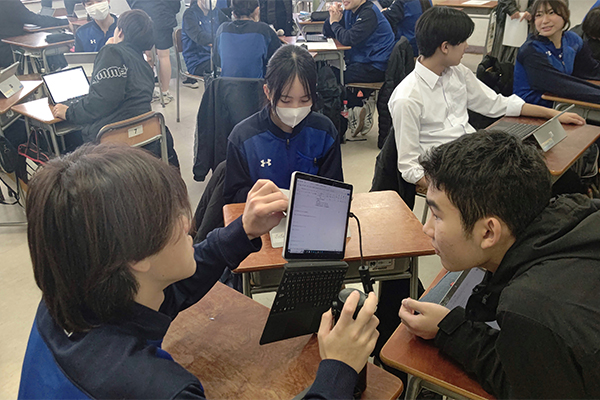
In 2024, we implemented a lesson utilizing generative AI at a public junior high school in Sibuya Ward. The lesson, aimed at third-year junior high school students, involved working with the generative AI and classmates to develop a self-introduction essay. First, students reflected on their three years of school life and listed at least three instances where they felt they had grown, along with supporting anecdotes. Next, they used the generative AI to compare and analyze these anecdotes, considering which one best highlighted their strengths. The interaction with the AI was designed as a selection-based button system; when a student pressed a button to compare anecdotes, the AI would highlight the characteristics of each. However, the generative AI does not always produce the desired or correct answer. Therefore, we placed great importance on the process of discussing the AI's output in groups of three. Instead of simply using the AI silently, students exchanged opinions with their friends, asking questions like, "This is the result we got, what do you think?", and collaboratively created their self-introduction essays. We believe that this dialogue process is crucial. After writing the essays through such in-depth discussions, the students also utilized the AI's checking function. By providing a function to check the balance between claims and facts, students realized, "I didn't write about this event properly," and repeatedly refined their writing through trial and error.

How will learning be evaluated?

Before and after this learning experience, students were asked to write down on a worksheet what they considered to be the most important points when writing a self-introduction essay. By analyzing their responses, we were able to evaluate the system by checking how many students came to understand, for example, how much more students realized the importance of clearly distinguishing between facts and opinions after going through this learning activity, what changes were observed in their actual writing, and whether students were able to engage in deeper dialogue with each other based on the AI-generated answers.
However, these kinds of writing skills cannot be acquired in a short period of time. Therefore, in the future, we need to carefully examine whether students can properly utilize generative AI in continuous learning, such as in junior high school Japanese language classes, and whether this technology will become firmly established as their own skill, or whether the effect will be limited to a temporary one immediately after using the app.

Are there any other examples of learning using generative AI?

In public junior high schools in Sagamihara City, teachers are using pre-prepared prompts to allow students to answer questions from a generated AI and deepen their understanding of the material through dialogue with other students based on their answers. For example, they are experimenting with improving the quality of endurance running by leveraging the strengths of both humans and AI, with the help of classmates and the generated AI. This is a challenge to see how AI can be used in learning in various fields, not just core subjects, but also art and physical education.
What's essential in these initiatives is not simply accepting the AI's answers at face value, but creating opportunities for students to think for themselves, such as discussing the answers with their classmates. If generative AI is introduced into learning without much thought, students tend to become passive, thinking, "If I ask the AI, I'll get the answer." However, AI is merely an "additional" element; the core of learning should be dialogue with others and the ability to think for oneself. We want to continue to nurture this kind of learning in the future.

Please tell us about your outlook for the future.

Up until now, the focus has been on helping learners, including junior high school students, acquire literacy skills, or "reading and writing abilities," through generative AI and information terminals. However, from now on, it is necessary to shift towards education that fosters more advanced literacy by combining the use of cutting-edge technology with human interaction, while building upon these basic skills. In fact, such a change is already beginning little by little.
Going forward, we aim to support the creation of learning support systems and lessons that enable children to deepen their learning through dialogue with each other while utilizing generative AI tools. In undergraduate and graduate seminars, students are also working together to explore such learning support methods. Furthermore, we aim to utilize and test these ideas in junior and senior high schools, and to develop them in a more practical form while improving the completeness of the project we are conducting with the Japan Kanji Aptitude Testing Association.

Related Content

  • College of Education, Psychology and Human Studies, Department of Education
  • Posted on 2025/03/14
  • Yokohama City Library introduces Japan's first AI-based book search system
  • Professor Toshihiko Nozue
  • In the "Near-future libraries and new learning" project led by Professor Toshihiko Nozue, a book search system using AI developed in collaboration with Fujitsu Japan Ltd. was introduced to the Yokohama City Library in January 2024 and to the Okinawa Prefectural Library in March. This is the first AI-based search system for library books in Japan (according to the research project). The project aims to create a model that evolves libraries from mere "book collections" to places that support the learning of each and every citizen. This system was developed as one of the concrete tools toward the new model. It is designed so that users can find literature that they have not been able to find before, according to their interests and needs, without relying on keywords. This initiative presents the future of learning and the way libraries should support learning.

For inquiries regarding "research and industry-government-academia collaboration," please click here

Return to the list of "Topics Creating the Future"