AGU RESEARCH

Topics that shape the future
- Closer look at research results -

Aoyama Gakuin University faculty members:
He is an uncompromising researcher.
Aiming for a prosperous society,
We are always conducting cutting-edge research.
We will explore the research results of our faculty members who are shaping the future.

  • College of Science and Engineering, Department of Chemistry and Biological Science
  • Published on 2026/06/23
  • We are challenging ourselves to create phenomena never before seen through the development of highly functional photochromic molecules.
  • Professor Jirou Abe
  • College of Science and Engineering, Department of Chemistry and Biological Science
  • Published on 2026/06/23
  • We are challenging ourselves to create phenomena never before seen through the development of highly functional photochromic molecules.
  • Professor Jirou Abe

TOPIC

Professor Jiro Abe is leading the international research on high-performance photochromic molecules through the development of high-speed photochromic molecules.

What is photochromic molecule development?

This research field involves designing and synthesizing "photochromic molecules," whose molecular structure and color reversibly change upon light irradiation, based on quantum chemical calculations. Since the 2000s, Professor Abe has brought about significant progress in this field through the development of numerous groundbreaking molecules, leading global research while receiving high international acclaim.

Global attention

One of the most symbolic achievements is the multiple publications in the Journal of the American Chemical Society, a particularly authoritative academic journal in the field of chemistry. This journal is an international academic journal that publishes research results that are recognized as having extremely high novelty and originality and of significant value in chemical research. Professor Abe's research has been published in this journal multiple times, starting with the 2009 paper "A Fast Photochromic Molecule That Colors Only under UV Light," and his results have been highly praised internationally.

Evaluation points

Photochromic molecules, used in applications such as photochromic lenses, not only change color when exposed to light, but also possess the characteristic of reversibly changing their molecular structure itself. Leveraging this property, technological applications in various fields such as display materials, recording media, and sensors are expected in the future. Professor Abe has been working on developing "high-speed photochromic molecules" that instantly revert to their original state when light is blocked after a color change. These research results are highly regarded both domestically and internationally as foundational technologies that will lead to future applications.


Illustration: Arrow

Explore the topic with your teacher

Professor Jiro Abe

Graduated from the Department of Applied Chemistry at Waseda University College of Science and Engineering. Completed the Master’s and Doctoral programs in Applied Chemistry at Waseda University Graduate School Graduate School of Science and Engineering. Doctor of Engineering. After serving as a research assistant, full-time lecturer, and associate professor at several universities, he was appointed as an associate professor in the Department of Chemistry at Aoyama Gakuin University College of Science and Engineering in April 2003.Since October 2010, he has served as a professor at this university College of Science and Engineering Department of Chemistry and Biological Science (following a departmental reorganization). His areas of expertise include photochemistry, physical chemistry, functional molecular chemistry, and structural organic chemistry. His primary research themes are the creation of functional molecular materials, physical chemistry, and organic photochromic molecules.

What are photochromic molecules?

Photochromic molecules are molecules that change their shape, or structure, when exposed to light energy, mainly ultraviolet light, and consequently change their color, or more precisely, the way they absorb light, in a reversible manner. A familiar example is photochromic lenses, or so-called photochromic sunglasses, which darken when exposed to ultraviolet light. This is because the surface of the lens is coated with a film containing photochromic molecules, causing the color to change when exposed to ultraviolet light outdoors.

If you have photochromic sunglasses on hand, try shining light on both the front and back surfaces of the lenses and compare how the lenses change color. You'll notice that the lens color doesn't change when light is shone on the back surface, indicating that the photochromic molecular film is only applied to the front surface. This is because the lens absorbs ultraviolet light from the back, preventing it from reaching the front surface. Photochromic molecules are also used in other products such as nail polish and clothing that change color with light, and were once applied to ski wear that changed color when exposed to sunlight.

The way a transparent lens changes color when exposed to ultraviolet light.

What are photochromic molecules used for?

Photochromic molecules not only change color, but their shape, or structure, also changes in response to light. This property allows molecules to be switched between two different states. For example, by associating each state with the digital data "0" and "1," they can be used as optical recording materials that can write and erase information with light. Research is also progressing in various cutting-edge fields, including molecular machines and photomechanical materials that operate in response to light, nanostructures whose shape and properties change in response to light, and catalysts whose functions can be switched by light. Furthermore, applications in the medical and life science fields are expected, such as technologies for observing the fine structures within cells with high resolution and technologies for controlling biological functions with light.

In recent years, "thermal energy storage technology," which utilizes photochromism to store solar energy as chemical energy, has also attracted attention. For example, when sunlight is shone on a colorless photochromic molecule, its molecular structure changes, and it becomes colored. This state has higher energy than the original colorless state, so by maintaining this state, energy can be stored within the molecule. Then, when the energy needs to be used, for example, at night when solar power generation is not possible, the molecule is returned to its original stable colorless state, and the energy difference when returning from an unstable state to a stable state is released as "heat." This heat is expected to have applications in power generation and heating. Thus, photochromic molecules are noteworthy molecular materials with expected applications in a wide range of fields, including information recording, energy utilization, medicine, and life sciences.

What kind of high-speed photochromic molecules were developed in your lab?

Photochromism, the phenomenon in which the structure and color of molecules reversibly change in response to light, has been known for a long time. However, many conventional photochromic molecules take several minutes to return to their original state after changing color, and the slow reaction rate has been a major challenge for applications.

Our laboratory was quick to address this challenge, and in 2005, we developed the world's first high-speed photochromic molecule that returns to its original colorless state in an extremely short time of approximately 180 milliseconds at room temperature. This is a groundbreaking molecule whose color disappears in less time than a blink. Furthermore, in 2008, we succeeded in developing a second-generation high-speed photochromic molecule with an even faster reaction rate.

These results represent a world-first achievement in enabling high-speed responses of photochromic molecules and were published in the prestigious academic journal "Journal of the American Chemical Society (JACS)." Furthermore, due to its novelty and high applicability, it was widely featured as a groundbreaking technology in various media outlets.

Why did it become such a big topic of conversation?

The key point is that we can now control the state of molecules, such as their color and shape, at high speed, in milliseconds. For example, consider photochromic lenses. When driving a car, if you enter a tunnel with colored lenses on, your vision suddenly becomes dark. However, by using photochromic molecules that quickly return to their original colorless state, the lenses can quickly return to colorless the moment you enter a tunnel, maintaining a bright and clear field of vision. Furthermore, the ability to control color changes at high speed opens up applications in video and display technologies. For example, in 2011, our technology was used in the artwork of media artist Daito Manabe.

A hologram is created by interfering an object wave, which contains the spatial information of an object, with a reference light, and recording the resulting interference fringes on a recording material. However, ordinary holograms are displayed as fixed "still images." On the other hand, by using high-speed photochromic molecules, it becomes possible to rapidly rewrite the interference fringes. In fact, we have succeeded in realizing the world's first hologram video using photochromic film.

Thus, the ability to rapidly control the colored and colorless states has greatly expanded the potential applications of photochromic molecules. We believe this is one of the reasons why this research has attracted so much attention.

Since then, the world's first high-speed "reverse" photochromic molecules have also been developed.

While typical photochromic molecules change color when exposed to light, molecules that lose their color when exposed to light are called "reverse photochromic molecules." Such molecules are rarely found in nature, and there have been only a limited number of examples of their artificial synthesis. Furthermore, many conventional reverse photochromic molecules require a long time for their color to recover, making the achievement of high-speed response a major challenge. In our research, we accidentally discovered a molecular structure in which the color disappears in an extremely short time when exposed to light.

The paper summarizing these results, like the one on the development of the high-speed photochromic molecule mentioned earlier, was published in JACS and attracted attention from many researchers. Currently, research based on the molecule we developed is spreading, mainly among researchers in Europe, and related papers are being actively published.

Does this technology also have a wide range of potential applications?

Conventional photochromic molecules have the property of changing color when exposed to light, meaning that the irradiated light is easily absorbed near the surface of the material, resulting in a problem where the light does not penetrate sufficiently into the interior of the object. Therefore, photochromic reactions mainly occurred near the surface.

On the other hand, high-speed inverse photochromic molecules have the property of losing their color when exposed to light, allowing light to penetrate more easily into deeper parts of an object. Furthermore, it is possible to eliminate color using near-infrared light, which is invisible to the human eye, making it possible to achieve the mysterious phenomenon of manipulating color at will, almost like magic.

By utilizing this property, for example, high-speed inverse photochromic molecules can be incorporated into liquid crystal materials, and by changing the shape of the molecules in response to light, the arrangement of liquid crystal molecules and the pitch of the helical structure can be changed in conjunction. As a result, the wavelength of light reflected by the liquid crystal, that is, the colors visible to our eyes, can be freely controlled. This mechanism has the potential to develop into a new display technology that creates colors and images using light signals, unlike conventional displays that control display using electrical signals. In the future, it is expected to be applied to next-generation displays with significantly reduced power consumption and light-controlled display materials.

How are these various molecules developed?

Research into creating new molecules begins with mentally considering "what function we want it to have" and then visualizing the molecular structure that will achieve it. Next, quantum chemical calculations are performed based on that structure to predict how it will respond to different wavelengths of light, how quickly it will return to its original state, and so on. Only if the results indicate that "this is feasible" do we proceed to the actual synthesis. Particularly difficult in this process is devising the "synthesis route" from scratch—how to actually create the unknown molecule designed on paper. The synthesis process is assembled like solving a puzzle, taking into account the feasibility and difficulty of the reactions, as well as the constraints on the reagents that can be used. A single reaction step can take several weeks, and it is not uncommon for the synthesis of the target molecule to take several months to several years. Furthermore, even if the target molecule is synthesized after a long time, it is not possible to know whether it will exhibit the expected properties until light is actually shone on it. The development of new molecules is research that involves meticulous design, painstaking experiments, and a great deal of trial and error.

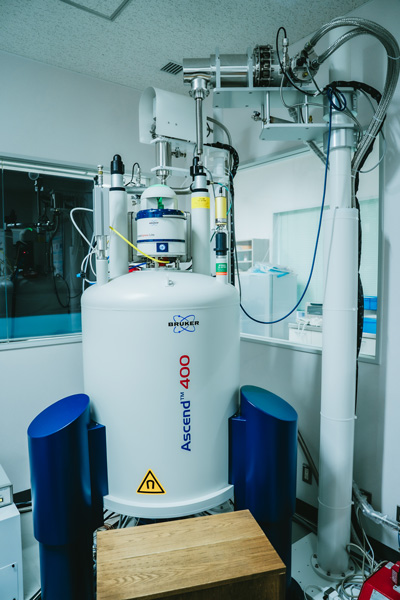
Superconducting high-resolution nuclear magnetic resonance (NMR) spectrometer installed in the Abe Laboratory

What do you find most rewarding about such challenging research?

No matter how difficult the process, the joy of seeing molecules react as expected, or even beyond expectations, when finally illuminated with light, is immeasurable. I find great appeal in "discovering a unique phenomenon that no one in the world has ever seen before." That joy is the driving force behind my continued research. Of course, research that improves existing results and leads to practical applications and scaling up is also very important. However, I personally believe that pioneering entirely new fields is the true essence of research. I dedicate myself to research every day in order to experience that joy.

What kind of research do you plan to pursue going forward?

Currently, I am interested in multifunctional molecular systems that not only change color, but also allow us to control magnetism (that is, magnetic properties), molecular movement, and even how molecules aggregate using light. Molecules are made up of atoms bonded together. A change in the shape of a molecule means a change in how atoms are bonded together. Normally, atoms are bonded together by pairs of electrons, and in this state, magnetism cancels out. However, if we can use photochromic reactions to break and reconnect these bonds with light, we can change the state of electron spin and manipulate the magnetism of molecules at will with light. This type of research can be called "optical control of electron spin."

In the future, I would like to develop these spin state control technologies into areas of intersection with molecular electronics and life sciences. For example, I see great potential in realizing technologies that control biological functions using light, and technologies that allow for more precise observation of phenomena occurring within cells. Originally, I was involved in quantum chemistry research, so I have a strong interest in the area where chemistry and physics, especially quantum science, overlap. My major research theme is to create new phenomena that no one has ever seen before from this boundary area.

Please give a message to prospective students and university students who are about to embark on research.

The greatest appeal of research is encountering unknown phenomena that no one has yet discovered and getting closer to new discoveries through your own efforts. Of course, experiments often don't go as planned, and there are many failures and trial and error. However, beyond that, there are moments when you encounter discoveries that exceed your expectations. I believe that this is the greatest thrill of exploring science. I give my students in the lab somewhat strict guidance, such as requiring them to submit reports every week. This is because I believe that the habit of thinking, recording, and reflecting every day will hone their thinking skills as researchers and lead to great achievements in the future. In fact, my students have published many research results in the form of papers.

If we liken the knowledge you've accumulated up to high school to "stars," then university research requires the ability to connect those stars and create your own "constellation." What's important is intellectual curiosity—the feeling of "why?" and "that sounds interesting." The experience of finding your own questions, thinking persistently, and continuing to challenge yourself will undoubtedly be a great asset, no matter what path you choose in the future.
I encourage everyone to enjoy the challenge.

*The affiliations, Position, and research topics of the individuals listed are as follows:
This information is generally based on the time of the interview.

Related Content

  • College of Science and Engineering, Department of Chemistry and Biological Science
  • Posted on 2024/07/02
  • Investigating the luminescence properties of helical complexes that take advantage of the properties of rare earth elements
  • Professor Miki Hasegawa
  • A complex is a compound in which a metal ion is surrounded by organic molecules or other ions. Professor Miki Hasegawa of the Faculty of Science and Technology, who has long been developing molecules that emit light by using rare earths in the metal part and elucidating their functions, has been awarded the Rare Earth Society of Japan's most prestigious award, the Shiokawa Award. His original approach to creating a helical structure in which molecules are wrapped around rare earth ions has also attracted a great deal of attention, as has his creation of molecular models with various luminescent functions.

  • Faculty of Science and Engineering, Department of Physical Sciences
  • Posted on 2023/06/19
  • Pursuing development methods for high-temperature superconducting magnets
    - Aiming to realize compact and versatile NMR -
  • Assistant Professor Takanori Motoki
  • Assistant Professor Takanori Motoki's research has been selected for NEDO's "Mito Challenge 2050" as the establishment of bulk magnet growth technology that realizes high-temperature superconductivity will lead to the miniaturization and power saving of NMR (nuclear magnetic resonance) devices used in a wide range of fields. NMR devices used for structural analysis of organic compounds etc. need to be cooled to extremely low temperatures, but the high-temperature superconducting magnet growth technology developed by Assistant Professor Motoki is expected to lead to operation in a wider temperature range than before, realizing the development of easier-to-use devices.

  • Faculty of Science and Engineering, Department of Physical Sciences
  • Posted on 2023/06/22
  • Successfully generated space plasma shock waves in a laboratory.
    The results were published in a US scientific journal.
  • Professor Ryo Yamazaki
  • Cosmic rays are thought to be created by space plasma shock waves present in supernova remnants, etc. Until now, the only experimental research method for clarifying their mechanism was satellite observation, but a joint research group of eight universities led by Professor Ryo Yamazaki of Aoyama Gakuin University has succeeded in generating space plasma shock waves in a laboratory through experiments using a large laser, and published the results in a paper in the American scientific journal "Physical Review E."

For inquiries regarding "research and industry-government-academia collaboration," please click here

Return to the list of "Topics Creating the Future"